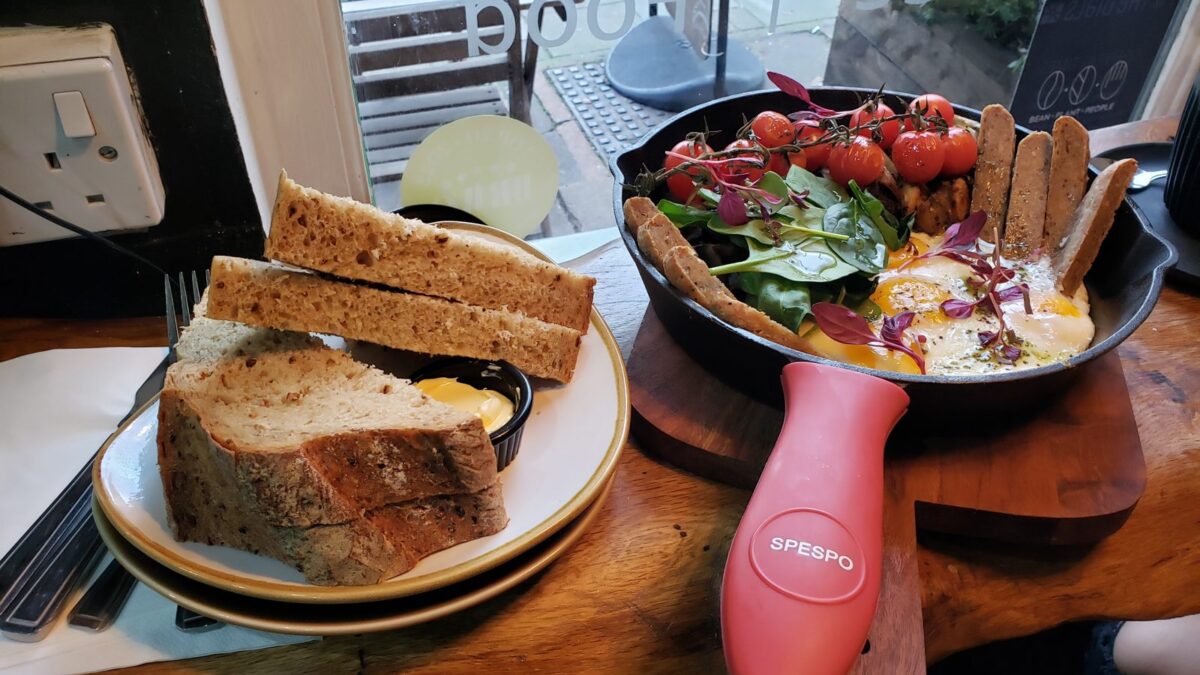
There are two honest ways to finish a breakfast skillet once the eggs go over the potatoes: cover it and let the stovetop do everything, or slide the pan under a hot grill for the last few minutes. I’ve cooked this both ways more times than I can count, on the same 26cm cast-iron pan, and they give genuinely different food.
Two Ways To Finish A Breakfast Skillet
The shared part is the same either way: potatoes crisped first, onion and pepper softened into them, eggs whisked with milk and poured over, cheddar on top. The split happens in the last four minutes, and it decides three things — how the cheese behaves, how tender the eggs are, and whether the base of the potatoes stays crisp.
Short version, if you want it now: the lid method wins on egg texture and I use it most mornings. The grill wins on the cheese and on looks. Below is why, and when I switch.
Method A: Lid On The Stovetop
Heat comes only from below, and steam trapped under the lid sets the top of the eggs. That steam is gentle — it’s at 100C, and it condenses on the egg surface rather than blasting it. The result is eggs that stay soft and slightly custardy right to the top, with no browned skin.
You need the burner low. On my hob that’s the second-lowest setting for two and a half to three minutes. Any higher and the base of the egg layer overcooks while the top is still liquid, which is the one real failure mode here.
The cheddar melts but doesn’t colour. It goes glossy and stretchy and sits in a smooth sheet. Some people find that pale; I like it, because it means the cheese still tastes of cheese rather than of toasted milk solids.
The cost: condensation. Lift the lid straight up and a few drops land on the surface, leaving small pale wet patches. Tilt the lid away from you as you lift and most of it runs off at the edge. It’s a two-second habit and it took me an annoyingly long time to work out.
Method B: Straight Under The Grill
Radiant heat from above at roughly 220C or more, depending on your grill. It sets the egg surface fast and it browns the cheddar into blistered patches, which is where the flavour argument for this method sits — those browned spots taste distinctly nuttier and saltier than melted cheese does.
It’s also quick. Three to four minutes with the pan about 15cm below the element, and there’s no lid to manage.
The problem is the gradient. The top 5mm of egg is being cooked at over 200C while the middle is still at maybe 60C. To get the centre set you often overshoot the surface, and the eggs closest to the top go slightly firm and squeaky. On a good day it’s imperceptible. On a distracted day it’s the difference between a nice skillet and a rubbery one, and grills give you almost no warning — the change from golden to burnt is about 40 seconds.
It also means the pan gets very hot on top, so the handle will be hot too, which is worth saying out loud because I have grabbed a cast-iron handle bare-handed out of a grill and I only did it once.
Side By Side
| Lid on stovetop | Under the grill | |
|---|---|---|
| Time for final stage | 2.5 to 3 min | 3 to 4 min |
| Egg texture | Soft, custardy throughout | Firmer top, softer middle |
| Cheese | Melted, pale, glossy | Browned, blistered, nuttier |
| Potato base | Stays crisp | Stays crisp |
| Margin for error | Wide, roughly 90 sec | Narrow, roughly 40 sec |
| Needs oven-safe pan | No | Yes |
The potato row surprises people. I expected the grill to dry the base out, and it doesn’t — the potatoes are insulated by everything above them, and the base is set by how you cooked them in step one, not by the finish.
Ingredients
- 500g potatoes, diced into 1cm cubes
- 2 tbsp olive oil
- 1 small onion, diced
- 1 bell pepper, diced
- 2 garlic cloves, minced
- 1/2 tsp smoked paprika
- 6 large eggs
- 1/4 cup milk
- 1 cup sharp cheddar, grated
- A knob of butter
- 2 tbsp chopped chives and parsley
- Salt and black pepper
Use a waxy or all-rounder potato. Floury ones like a big baking potato break down at the edges when you stir them and you end up with mash in the gaps. And grate the cheddar yourself — pre-grated is coated in starch to stop it clumping, and that starch makes it melt grainy under a lid.
Instructions
- Heat the oil in a 26cm cast-iron or heavy skillet over medium. Add the potatoes in a single layer, season with salt, pepper and the paprika, and leave them alone for 4 minutes before the first stir.
- Cook a further 8 minutes, stirring only every 2 to 3 minutes, until deeply golden and tender to a fork. Undisturbed contact is what makes the crust; constant stirring gives you pale steamed cubes.
- Push the potatoes to one side. Add the onion and pepper to the clear space and cook 4 to 5 minutes until soft, then stir the garlic through for 30 seconds.
- Whisk the eggs with the milk, a pinch of salt and pepper until uniform and slightly frothy.
- Stir the butter through the potato mixture and spread everything level. Turn the heat to low.
- Pour the eggs over evenly, tilting the pan so they run into the gaps. Let them sit undisturbed 2 to 3 minutes, until the outer 2cm has set and the centre is still loose.
- Scatter the cheddar over the surface.
- Lid method: cover and cook 2.5 to 3 minutes on low, until the centre no longer ripples when you shake the pan. Lift the lid tilted away from you. Grill method: slide the pan 15cm under a preheated hot grill for 3 to 4 minutes, watching it the entire time.
- Rest off the heat for 2 minutes, scatter the herbs, and cut into wedges in the pan.
Where The Grill Method Loses, And When I Still Use It
It loses on the thing you actually eat most of, which is the egg. A skillet is mostly egg by volume, and soft beats browned there. The grill’s advantage is concentrated in a thin cheese layer on top — real, but small.
It also loses on equipment. The lid method works in any pan you own. The grill needs an oven-safe skillet with a metal handle, and if your only heavy pan has a plastic one you’re out.
So the lid is my default and I’d tell anyone to start there. I switch to the grill in exactly two situations: when I’m serving it at the table to people and I want the browned top, and when I’ve made it in a 30cm pan for five or six, because a wider, shallower egg layer sets fast enough under the grill that the gradient problem mostly disappears.
The part neither method fixes is the potatoes, and that’s where this dish is actually won or lost. Twelve minutes is the real floor for 1cm cubes from raw. If you want to shortcut it, boil them whole the night before, chill them, then dice and fry — cold cooked potato crisps faster and more evenly than raw, and it’s the same principle behind good crispy hash browns. The seasoning logic here is closer to a classic breakfast hash than to a frittata, which is why I go heavier on paprika than seems sensible.
If you’re building a bigger plate around it, breakfast sausage patties cooked in the same pan first give you fat to fry the potatoes in, which is a straight upgrade. And a batch of cheddar herb scones on the side is the version I make when it’s a Sunday and nobody has anywhere to be.