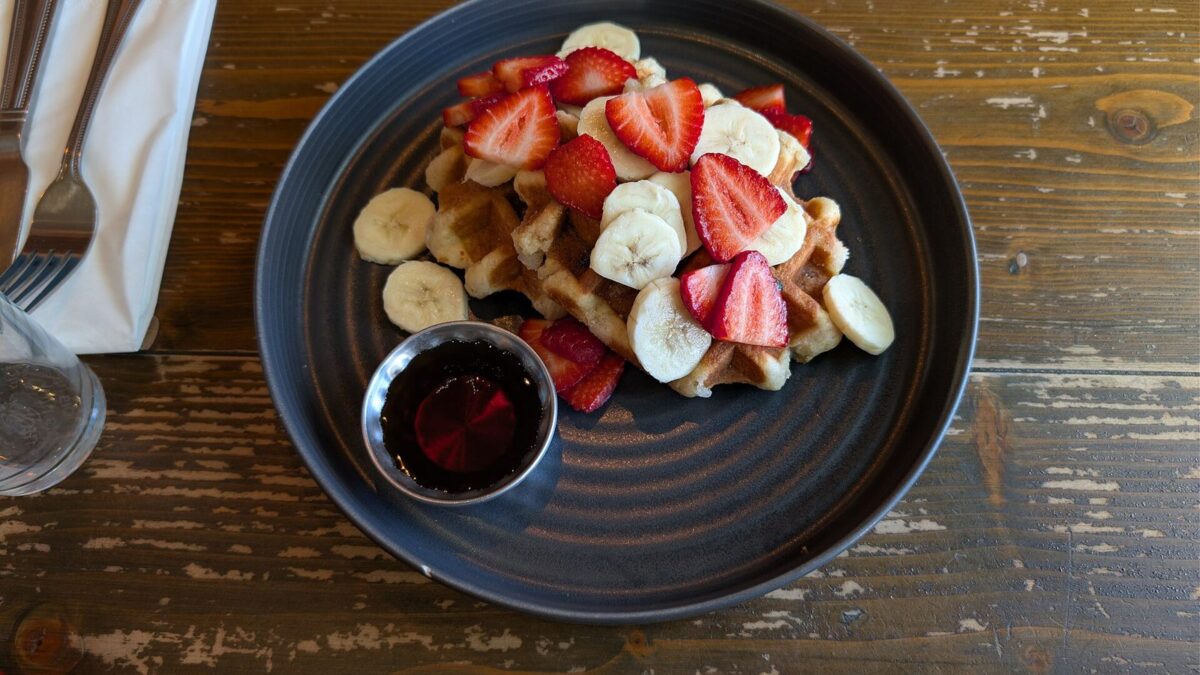
A Belgian waffle should crack when you cut it. If yours bends instead, the problem is almost never the recipe, it is the iron, the batter’s water content, or what you did with the waffle in the two minutes after it came out. This is the long version: what the batter is doing, how to read your iron, how to make the batter ahead, how to freeze them properly, and how to scale the whole thing up for a crowd.
The recipe itself is a standard 2-cup-flour batter with the whites whipped separately. It makes four to five deep waffles in a 7-inch round iron, which is two generous breakfasts or four polite ones.
Belgian, Brussels, Liege: What You Are Actually Making
Three different things share the name. A Brussels waffle is the light, rectangular one with deep pockets, raised with yeast or whipped whites, crisp outside and almost hollow inside. A Liege waffle is made from a stiff brioche dough studded with pearl sugar that caramelises against the plates, dense and chewy and eaten in the hand. What most people outside Belgium call a Belgian waffle is a chemically leavened cousin of the Brussels, which is exactly what this recipe is.
That distinction matters for one practical reason: if you have been searching for why your waffles are not chewy and sugar-crusted, you have been reading about Liege waffles and this recipe will never do that. It makes the light, crisp, pocket-deep kind.
Choosing an Iron, and Coping With the One You Own
The single spec that matters is grid depth. Belgian irons cut pockets around 1 inch deep; a standard American waffle iron cuts about 3/8 inch. Deep pockets mean more surface area against hot metal, which means more crust per waffle, which is the entire point.
Flip irons are better and I will defend it. Rotating the iron 180 degrees right after you close it spreads the batter evenly across both plates instead of letting gravity pull it to the bottom, and you get an even top crust rather than a pale one. If yours does not flip, you can partly compensate by using slightly less batter so it does not pool.
Cheap irons run cool and have no thermostat worth trusting. Mine produced pale first waffles for years before I worked out it simply was not up to temperature when the light said it was. Preheat any budget iron for a full 10 minutes, not the 3 or 4 the light suggests, and write off the first waffle as a test. It tells you your timing for the rest of the batch.
What Each Thing in the Batter Is Doing
Plain all-purpose flour at roughly 10 to 12 percent protein is right here. Bread flour builds too much gluten and gives you something closer to a pancake with grooves. If you want a harder shell, swap 1/4 cup of the flour for cornstarch, which has no gluten at all and dries out faster against the plate.
A tablespoon of baking powder for 2 cups of flour looks like a lot, and it is deliberate. Waffle batter sits in a hot enclosed space for four minutes, and you want the gas produced fast and early, before the crust sets and traps everything.
The 2 tablespoons of sugar are there for browning more than sweetness. Sugar caramelises against metal at temperatures the batter reaches easily, and it is a large part of why waffles brown while pancakes of the same batter would stay pale.
Half a cup of melted butter is the crisp. Fat coats the flour particles, limits how much gluten develops, and, more importantly, waterproofs the outer millimetre so steam escaping from the middle does not soften the crust on its way out. A low-fat batter can come off the iron crisp and be soft ninety seconds later.
The Whipped-Whites Question
Is it worth washing an extra bowl? Yes, and I say that as someone who resents washing extra bowls.
Beaten whites carry air that expands in the iron and sets into an open crumb. Folded into this batter they take the interior from tender to almost hollow, and a hollow interior holds less moisture, so the crust stays crisp longer on the plate. Whipping two whites to soft peaks takes about 90 seconds with a hand mixer.
Skip it if you must. Whisk the whole eggs into the wet mix and you still get a good waffle, just a denser one that goes soft a couple of minutes sooner. What you must not do is beat the whites stiff and dry. They will not fold in without breaking up, and you will find white streaks in the finished waffle.
Ingredients
- 2 cups all-purpose flour, spooned into the cup and levelled.
- 2 tablespoons granulated sugar, mostly for browning.
- 1 tablespoon baking powder, check the date on the tin.
- 1/2 teaspoon salt.
- 2 large eggs, separated, whites into a clean, dry bowl.
- 1 3/4 cups whole milk, at room temperature if you can manage it.
- 1/2 cup melted butter, cooled slightly so it does not scramble the yolks.
- 2 teaspoons vanilla extract.
- Cooking spray or melted butter for the plates.
- Toppings: maple syrup, berries, whipped cream, powdered sugar.
Instructions
- Preheat the waffle iron on its medium-high setting for a full 10 minutes, and set the oven to 200F (95C) with a wire rack in the middle.
- Whisk the flour, sugar, baking powder, and salt together in a large bowl for about 20 seconds, so the baking powder is evenly spread.
- In a second bowl, whisk the egg yolks with the milk, melted butter, and vanilla until smooth.
- Beat the egg whites with a hand mixer until they hold soft peaks that flop over at the tip, roughly 90 seconds. Stop there.
- Pour the yolk mixture into the dry ingredients and stir just until the flour disappears, about 15 strokes. Lumps the size of a pea are fine and mean you have not overworked it.
- Fold the whites in with a spatula in three additions, cutting down the middle and turning the bowl. Stop while a few streaks are still visible. The batter should look thick and puffy and hold a soft mound on the spatula.
- Grease the hot plates lightly, pour in about 3/4 cup of batter into the centre, and close the lid. If your iron flips, rotate it straight away.
- Cook for 4 to 5 minutes without opening the lid. Opening early tears the waffle in half along the setting crust.
- Move each finished waffle straight onto the oven rack in a single layer. Never stack them, because trapped steam softens the crust within a minute.
- Serve hot, with the toppings on the side so the waffle stays crisp on the way to the table.
Reading the Iron: Steam Is the Real Timer
Forget the ready light on most irons, which only measures plate temperature and knows nothing about your waffle. Watch the steam instead.
For the first two minutes after you close the lid, steam pours out of the seam in a thick plume. That is water leaving the batter. As the waffle nears done the plume thins to a wisp and then nearly stops, because there is little free water left to drive off. That is your cue, usually 4 to 5 minutes on a home iron.
Still streaming at 6 minutes means the iron is running cool, so turn it up a notch for the next one. Stopped at 3 with a dark waffle means turn it down. The steam tells you what is happening inside; the dial only tells you what the manufacturer hoped.
Batter Tonight, Waffles Tomorrow
Resting the mixed batter 20 to 30 minutes at room temperature is a real improvement. The flour hydrates fully, the batter thickens, and the crumb comes out more even. I do this while the iron preheats and the coffee happens.
Overnight is different. Baking powder starts working the moment it meets liquid, and a batter left eight hours in the fridge has spent most of its lift before it reaches the iron. Split the work instead: dry ingredients whisked and covered in one bowl, milk and butter and vanilla in a jar in the fridge, eggs separated into two covered cups. Morning assembly takes two minutes and the leavening is fresh.
Rested batter also looks thinner than it did. That is normal. Do not add flour to correct it.
Freezing Them So They Come Back Properly
Cool the waffles completely on a wire rack, 15 minutes at least. A waffle bagged while still warm will freeze with ice crystals in every pocket and reheat into a wet sponge.
Freeze them flat on a tray for an hour first, then transfer to a bag. They will not fuse together and you can take out one at a time. Three months is fine, though at my house they never last a fortnight.
Reheat straight from frozen. A toaster on medium, run twice, gives the best result, arguably better than the original because the second pass drives off more moisture. In an oven, 200C for 6 minutes directly on the rack. The microwave heats them through and ruins the texture, so only use it if you are drowning the waffle in syrup anyway.
Scaling the Batch
The batter scales cleanly, which is not true of every recipe. Here is the arithmetic done for you.
| Ingredient | Half batch (2 waffles) | Full batch (4-5) | Double (9-10) |
|---|---|---|---|
| All-purpose flour | 1 cup | 2 cups | 4 cups |
| Sugar | 1 tablespoon | 2 tablespoons | 1/4 cup |
| Baking powder | 1 1/2 teaspoons | 1 tablespoon | 2 tablespoons |
| Salt | 1/4 teaspoon | 1/2 teaspoon | 1 teaspoon |
| Eggs, separated | 1 | 2 | 4 |
| Whole milk | 3/4 cup plus 2 tablespoons | 1 3/4 cups | 3 1/2 cups |
| Melted butter | 1/4 cup | 1/2 cup | 1 cup |
| Vanilla | 1 teaspoon | 2 teaspoons | 4 teaspoons |
One warning on the double batch. Folded whites deflate as they sit, so the last waffles from a doubled bowl are visibly flatter than the first. Cooking for eight, whip and fold whites into half the batter, cook that, then fold the rest in when you are ready. Four extra minutes and the ninth waffle comes out like the first.
For what goes alongside, sausage patties can be shaped the night before and cooked in one pan while the iron works through the batter, keeping everything to a single burner.
Questions I Get About Waffles
Why is the outside crisp but the middle still soft?
Too much batter for the iron, almost always. The excess sits in the middle where heat reaches it last. Cut back to 3/4 cup and cook the same 4 to 5 minutes. If it persists, your iron is running cool and needs the longer preheat.
Can I use buttermilk instead of milk?
Yes, and the flavour is better for it. Replace the milk one for one and reduce the baking powder to 2 teaspoons, adding 1/2 teaspoon of baking soda to react with the acid. The batter will be thicker, so expect to spread it a little with the back of a spoon. The same swap logic drives the buttermilk pancake recipe if you want to see it in another format.
Why do my waffles stick to the plates?
Either the iron was not hot enough when the batter went in, or you opened it too early and tore the crust that was still forming. Non-stick coatings also wear out; if a well-preheated, well-greased iron still grabs, the coating has gone.
Can I add fruit to the batter?
Berries burst against the plates and burn onto the coating, which is a miserable clean-up. Fold in fresh blueberries only if they are small and firm, or, better, cook the waffle plain and pile the fruit on top. The technique for keeping berries from sinking, which I use in blueberry pancakes, works here too if you insist. Leftover batter, incidentally, will not make decent pancakes; the fat content is too high, and you are better off with French toast for the same bread-and-syrup breakfast.
Can I make them dairy-free?
Oat milk and a neutral oil in place of the butter both work, though you lose some of the crust. Use 7 tablespoons of oil rather than the full half cup of butter, since butter is only about 82 percent fat and you would otherwise overshoot.