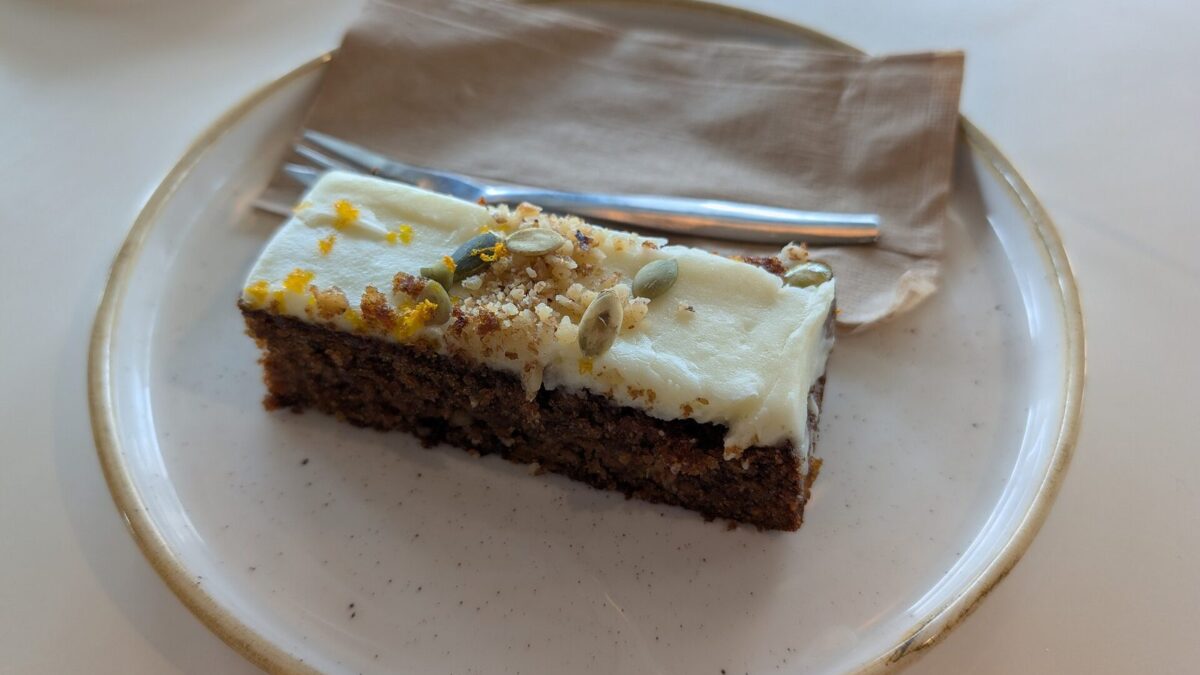
Five Ways This Cake Goes Wrong
Carrot cake fails in a small number of very specific ways, and every one of them has a cause you can see coming. I have hit all five, some more than once.
The middle is soggy
Almost always the carrots. Three cups of grated carrot is a lot of vegetable, and vegetables are water. If you grate them ahead and leave them sitting in a bowl, they weep, and that liquid goes into the batter along with them. Grate them within about ten minutes of mixing, and if a puddle has formed at the bottom of the bowl, tip it away. Do not squeeze them dry, though. That takes out the moisture you actually want in the crumb.
The other cause is pulling the cake too early. A skewer with a couple of moist crumbs is right; a skewer with anything glossy on it is not, and in a cake this dense the centre keeps cooking for a few minutes after you look.
The crumb is greasy
A cup of oil in a two-cup-flour cake is correct, but only if the batter emulsifies properly. Whisk the oil with both sugars until the mixture goes thick and slightly paler before the eggs go in. Skip that and the oil never really joins the party, and you get a cake that leaves a film on the roof of your mouth. I rushed this step once and the slices left grease marks on the plate.
The carrots vanish, or they don’t vanish enough
This is a grater problem and it is the one people get wrong most often. Food processor shredding discs cut short, thick batons that stay recognisably carrot-shaped after 35 minutes in the oven, so you get crunchy orange bits in a soft cake. The large holes on a box grater give you long, thin strands that soften completely and disappear into the crumb while still giving up their moisture. If someone at the table says they can taste carrot but cannot find any, you did it right.
The frosting slides off
Two causes and they usually happen together. The cake was still warm, which melts the butter in the frosting on contact. Or the cream cheese was too soft, which is a real risk since full-fat block cream cheese goes slack fast. Both layers must be at room temperature or below, and the frosting should hold a soft peak on the beater before it goes anywhere near the cake.
It sinks in the centre
Two teaspoons of baking soda plus a teaspoon of baking powder is a strong lift, deliberately, because the batter is heavy. If the oven door opens before 25 minutes, that lift collapses and takes the middle down with it. The second cause is overmixing after the flour goes in, which is worth saying twice.
Grate Size Is the Decision Nobody Explains
I want to stay on this for a minute because it changed my cake more than any other single thing.
Five to six medium carrots gives you your three cups. On the large holes of a box grater that takes maybe four minutes and leaves you with a mound of soft, floppy strands. In a food processor it takes forty seconds and leaves you with something closer to matchsticks.
Speed is genuinely tempting. But the matchsticks do not fully break down at 350F in 35 minutes, and a cake with visible carrot pieces reads as a vegetable cake in a way that puts people off. The strands do break down. Four minutes of grating is the price. I pay it, and I use the flat side of a peeler to do the last stub of each carrot so I keep my knuckles.
Ingredients
- 2 cups all-purpose flour — spooned and levelled, not scooped, for a light crumb.
- 2 teaspoons baking soda — the main lift for this cake.
- 1 teaspoon baking powder — for a little extra rise.
- 2 teaspoons ground cinnamon — the signature warmth.
- 1/2 teaspoon ground nutmeg plus a pinch of ground ginger.
- 1/2 teaspoon salt — balances the sweetness.
- 1 cup vegetable oil — what keeps this cake moist for days.
- 1 cup granulated sugar and 3/4 cup packed brown sugar — the brown sugar adds depth.
- 4 large eggs — at room temperature.
- 2 teaspoons vanilla extract — for rounding out the flavour.
- 3 cups grated carrots — about 5 to 6 medium carrots, grated fresh.
- 8 oz cream cheese and 1/2 cup butter, softened, for the frosting.
- 3 cups powdered sugar — sifted, for a smooth frosting.
Instructions
- Heat the oven to 350F (175C). Grease two 9-inch round cake pans and line the bases with parchment so the layers release cleanly.
- In a medium bowl, whisk the flour, baking soda, baking powder, cinnamon, nutmeg, ginger and salt together. Set the dry mixture aside.
- In a large bowl, whisk the oil, granulated sugar and brown sugar until well combined and slightly thickened. Add the eggs one at a time, whisking after each, then stir in the vanilla.
- Pour the dry ingredients into the wet and stir gently with a spatula just until no streaks of flour remain. Do not overmix or the cake turns dense.
- Fold in the grated carrots until evenly distributed. The batter will look thick and heavily flecked with orange.
- Divide the batter between the two pans and smooth the tops. Bake for 32 to 38 minutes, until a skewer in the centre comes out with just a few moist crumbs.
- Cool the cakes in their pans for 15 minutes, then turn them out onto a wire rack to cool completely before frosting.
- For the frosting, beat the softened cream cheese and butter until smooth, then add the powdered sugar and a splash of vanilla. Beat until fluffy and spreadable.
- Set one layer on a plate, spread with frosting, top with the second layer, and frost the top and sides. Slice and serve.
Frosting That Stays Where You Put It
Beat the cream cheese and butter together first, on their own, until there is not a single lump. Lumps at this stage never come out later, and you will be chasing them with the spatula on the side of the cake.
Sift the powdered sugar. I know. But three cups of unsifted icing sugar carries enough small hard clumps to give you a gritty frosting, and once it is beaten in there is no fixing it.
If the frosting goes loose, and it will on a warm day, put the whole bowl in the fridge for 20 minutes and beat it again for ten seconds. Adding more powdered sugar to thicken it just makes it sweeter and eventually cloying. Cold is the fix, not sugar.
One more: give the assembled cake half an hour in the fridge before slicing. The frosting firms, the layers settle, and you get a clean cut instead of a smear. The same trick works on classic chocolate cake, and it is more or less mandatory with New York cheesecake.
What I Add, and What I Leave Out
Toasted walnuts, 3/4 cup, chopped small and folded in with the carrots. Toasting matters more than the nut choice; raw walnuts in a moist cake go soft and slightly bitter, and eight minutes at 350F fixes that entirely.
Crushed pineapple I have stopped adding. It is traditional in a lot of versions and it does make the cake moister, but drained or not it pushes this particular batter into soggy territory, and the flavour muddles the cinnamon. That is my opinion and plenty of people will tell me I am wrong.
Raisins, plumped in hot water for ten minutes and patted dry, are a genuine improvement if your household likes them. Mine is split down the middle, so I usually don’t.
The Cake Is Better Tomorrow
Bake it a day ahead if you can. The spices settle, the crumb goes from slightly loose to properly moist, and the frosting has time to set against the cake instead of sitting on top of it. Store it covered in the fridge, then take it out 45 minutes before serving, because fridge-cold cream cheese frosting is waxy and fridge-cold cake tastes of almost nothing.
If you have leftover batter or you simply want the flavour without the layer-cake commitment, the same spice mix works beautifully baked as a single-layer loaf, along the lines of cinnamon applesauce cake or the streusel-topped cinnamon coffee cake, both of which skip the frosting entirely and are a lot easier to carry to someone’s house.