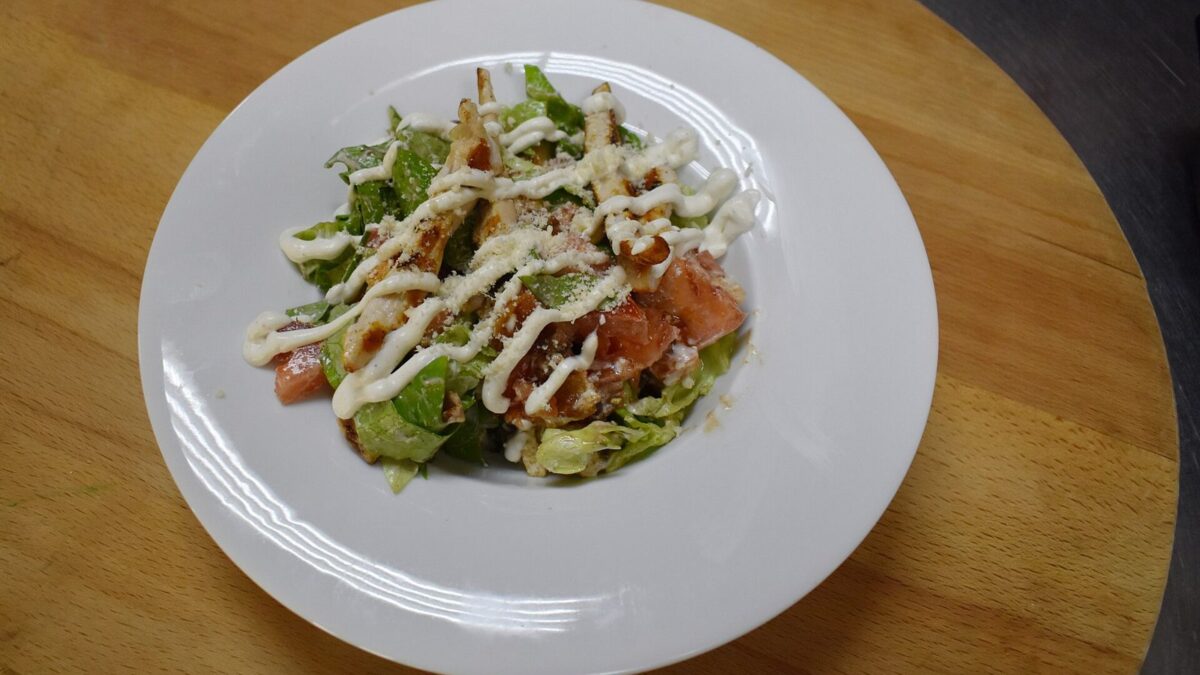
Nearly every argument about Caesar salad is an argument about the dressing, which is fair, because the dressing is the dish. Romaine and croutons are just the delivery system. So the four things people most often get wrong all live in that one bowl.
I have made this salad more times than any other salad in my kitchen, and I spent about two years making it badly on purpose — anchovy-free, because I thought I disliked anchovies. I was wrong in a specific way that is worth explaining.
Myth: the anchovies are optional
They are the backbone. Four fillets mashed into a dressing that coats two large heads of romaine will not taste of fish. They dissolve into salt and savor, and what you notice is that the dressing suddenly has a bottom to it.
Try it side by side once and you will never ask again. Make the dressing without anchovy, taste it on a leaf, then mash in the fillets and taste a second leaf. The first tastes like lemony mayonnaise. The second tastes like Caesar.
The sneaky part: plenty of "no anchovy" recipes call for a splash of Worcestershire sauce instead. Worcestershire is an anchovy product — anchovies are on the Lea & Perrins label. Swapping one for the other is not removing fish, it is removing fish you can see.
Myth: real Caesar has raw egg in it, full stop
The dressing needs an emulsifier, not specifically a raw one. Caesar Cardini’s version, as his daughter described it, used a coddled egg — dropped into boiling water for around a minute, then cracked into the bowl while still barely set. That is closer to warm than raw, and it whisks in beautifully.
Three routes that all work:
- Raw yolk — the smoothest, thickest result, and what the recipe below uses.
- Coddled egg — 60 seconds in boiling water, then straight into cold. Slightly looser dressing, faintly richer.
- Mayonnaise base — 3 tablespoons of good mayonnaise in place of the yolk and most of the oil. Whisk in the lemon, mustard, garlic and anchovy. This is the version I make when I am feeding my in-laws, and nobody has ever noticed.
Raw egg does carry a salmonella risk, and that risk is not evenly spread. Pregnant women, young children, older adults and anyone with a weakened immune system should skip raw yolk — use pasteurized eggs or the mayonnaise route instead. I am a home cook, not a food safety authority, so if you are cooking for someone in one of those groups, follow your local food agency’s guidance rather than mine.
Myth: chicken was always part of it
It was not. The 1924 Tijuana original was whole romaine leaves, dressed, stacked on a plate and eaten with your fingers by the stem. No chicken, no bacon, no avocado. Grilled chicken arrived decades later when American restaurants needed the salad to work as a main course.
None of which makes chicken Caesar bad. It is a genuinely good lunch, and if that is what you are after, the chicken Caesar wrap handles it better than a plate does. Leftover herb roast chicken, sliced cold, is my usual source. Just do not call it the classic and expect nobody to argue.
Myth: bottled dressing is close enough
Read the back of a bottle sometime. Most supermarket Caesar dressings are built on soybean oil, thickened with xanthan gum, and get their savory note from cheese powder rather than Parmesan and anchovy. Shelf-stable is exactly the problem: a real Caesar dressing is a live emulsion of oil, yolk and acid, and it tastes like it for about three days. The homemade version takes six minutes with a fork and a bowl. That is the whole case.
Is Caesar salad vegetarian?
Only if you build it that way, and the standard version is not. Anchovies are fish. Worcestershire contains anchovy. Parmigiano Reggiano is made with animal rennet, so strict vegetarians count it out too. Three separate ingredients, all easy to miss.
For a genuinely vegetarian Caesar, drop the anchovies and add 2 teaspoons of finely chopped capers plus half a teaspoon of white miso. The capers bring the briny hit, the miso brings the savory weight. Then use a vegetarian hard cheese instead of Parmesan. It is not identical — it is about eighty percent of the way there, which is far better than the anchovy-free version I made for two years with nothing in their place.
Ingredients
- 2 large heads romaine lettuce — crisp, cold, and torn into bite-sized pieces.
- 4 thick slices of bread — day-old sourdough or ciabatta for the croutons.
- 1 large egg yolk — the base that makes the dressing creamy and emulsified.
- 4 anchovy fillets — mashed into a paste; the salad’s savory backbone.
- 2 garlic cloves — finely grated or crushed to a smooth paste.
- 1 tablespoon Dijon mustard — for tang and to help the dressing emulsify.
- 2 tablespoons lemon juice — freshly squeezed for brightness.
- 120ml olive oil — plus extra for toasting the croutons.
- 60g Parmesan — finely grated, with more shaved over the top.
- Salt and freshly ground black pepper — to season throughout.
Instructions
- Preheat your oven to 200°C. Tear or cut the bread into rough cubes, toss them with a few tablespoons of olive oil and a pinch of salt, and spread them on a baking tray.
- Bake the croutons for 8 to 10 minutes, turning once, until deeply golden and crisp all over. Set them aside to cool while you make the dressing.
- In a bowl, mash the anchovy fillets and garlic together into a smooth paste using the back of a fork. This ensures they distribute evenly through the dressing.
- Whisk in the egg yolk, Dijon mustard, and lemon juice until smooth and well combined. The mixture should look pale and slightly thickened.
- Slowly drizzle in the olive oil while whisking constantly, a little at a time, until the dressing turns thick, creamy, and glossy like a loose mayonnaise.
- Stir in the grated Parmesan, then season with plenty of black pepper and a little salt. Taste and adjust with more lemon if it needs brightening.
- Wash and thoroughly dry the romaine, then tear it into a large bowl. Any water clinging to the leaves will dilute the dressing, so dry it well.
- Pour the dressing over the romaine and toss until every leaf is lightly coated. Add most of the croutons and toss again gently.
- Transfer to plates or a serving bowl, scatter over the remaining croutons, and finish with generous shavings of Parmesan and a final crack of pepper.
The romaine rule I break on purpose
Tear the leaves, do not chop them. Cut romaine bruises along the edge and goes limp faster, visibly so within about twenty minutes on a warm day.
The rule I ignore is the one about using only the pale inner hearts. The dark outer leaves have more flavor and hold dressing better; they just need the tough spine trimmed out with two cuts either side. Throwing away half a head of romaine to get a photogenic salad has never made sense to me.
Dry the leaves properly. A clean tea towel and two minutes of patting works if you have no spinner. Wet romaine turns a thick dressing into a puddle at the bottom of the bowl, and no amount of extra Parmesan fixes it.
Getting the dressing thickness right
You are aiming for something that coats the back of a spoon and slides off slowly, roughly the consistency of double cream that has been whisked once. Thicker than that and it clumps on the leaves instead of coating them.
If it breaks — goes thin and separated because you poured the oil too fast — do not throw it out. Put a fresh yolk in a clean bowl and whisk the broken mixture into it a teaspoon at a time. It comes back. I have rescued it this way at least half a dozen times, usually because I got impatient at the oil stage.
Dressing keeps in a jar in the fridge for three days, and it thickens as it sits. Loosen it with a teaspoon of cold water before using. Serve the salad within about ten minutes of dressing it — romaine holds up better than most leaves, but not forever — and if you want it to stretch into a full meal without chicken, a hunk of caprese panzanella alongside covers the same bread-and-savor territory without repeating yourself. Fried protein is the other honest answer: crispy fried chicken on the side, not on top.