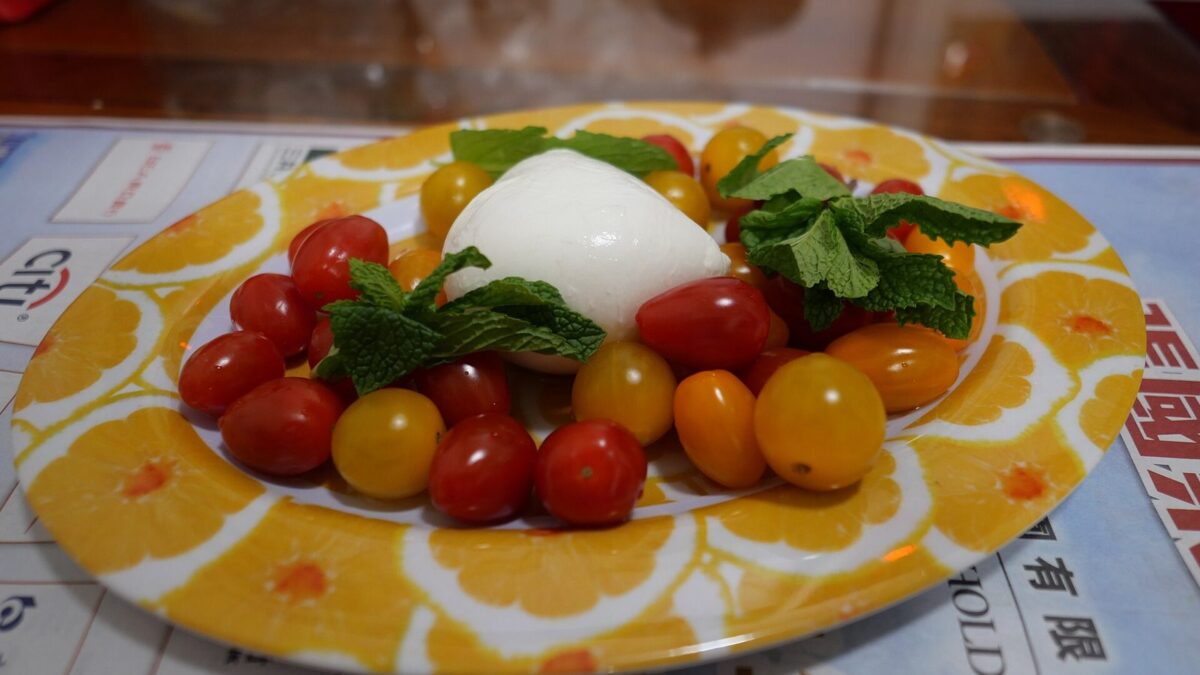
Almost every disappointing caprese fails in one of five specific ways, and four of them are fixable in the ten minutes before you sit down. The fifth is a shopping problem.
I’ve served all five versions. The watery one twice in the same summer.
Failure one: the puddle that appears under the slices
You plate it, you salt it, you carry it to the table, and by the time everyone’s sitting down there’s a pink pool of water and oil that’s separated out and gone thin. The bread you’d hoped to mop it up with just goes limp.
Cause: salt draws water out of tomato flesh through osmosis, and fresh mozzarella packed in brine is holding a lot of loose liquid of its own. Salt the slices on the plate and you’ve started a clock.
Fix: salt the tomatoes deliberately, ten minutes ahead, somewhere that isn’t the serving plate. Lay the slices on a wire rack over a tray, salt them, walk away. For four large tomatoes I usually get a couple of tablespoons in the tray. Blot the cut faces with kitchen paper. Drain the mozzarella onto paper for the same ten minutes — a ball of buffalo sheds a tablespoon or more.
The plate stays dry, and the tomatoes taste more of tomato, because you’ve concentrated what’s left.
Failure two: tomatoes that taste of absolutely nothing
This is the shopping problem and no technique rescues it. A tomato picked green and gassed to redness in transit has the colour without the sugars or the aromatics.
Fix: buy by weight and smell, not by looks. A good tomato feels heavy for its size and smells green and sharp at the stem scar — put it to your nose in the shop, people do this constantly and nobody minds. If it smells of nothing, it tastes of nothing.
And never, ever refrigerate a tomato you intend to eat raw. Below about 12°C the enzymes that produce its aroma compounds shut down, and the damage doesn’t fully reverse when you warm it back up. I keep mine in a bowl on the counter, stem-side down.
Out of season, switch to cherry or datterini tomatoes. They’re bred for sugar and grown fast, so a supermarket punnet in February beats a large winter beef tomato. Halve, salt, same as above.
Failure three: mozzarella with the texture of a squash ball
Straight from the fridge, fresh mozzarella is firm, faintly squeaky against the teeth, and tastes of cold and salt. Warm, it’s soft, milky and a bit sweet. Barely the same ingredient.
Fix: out of the fridge 30 minutes ahead, still in its liquid. Chilled fat needs real time to soften — five minutes on the counter does nothing to the middle of a 125g ball.
Check what you bought, too. Low-moisture mozzarella, the firm block sold for pizza, will not work; it’s built to melt, and cold it stays rubbery however long it sits out. You want the soft kind packed in liquid: buffalo, fior di latte, or bocconcini. Burrata is richer again and worth it if it’s on the shelf, though it collapses when cut, so tear it.
Failure four: basil that turns black in ten minutes
Bruised basil oxidises. Crushing the leaf cells releases enzymes that react with air, and the leaf goes green, then dark, then a nasty greyish black. Chopping with a dull knife is the fastest route there.
Fix: whole leaves where you can, and tear the larger ones by hand instead of cutting. Torn edges bruise less than sawn ones, which sounds backwards and holds up on the plate.
Add them after the oil, not before. A film of olive oil keeps air off the leaf and slows the oxidation, so oil-then-basil holds its colour noticeably longer. Small thing, visible at a lunch that runs long.
Keep the bunch stems-down in a glass of water on the counter, not the fridge — basil is tropical and it blackens in cold. Mine lasts about four days that way, against a day and a half in the salad drawer.
Failure five: balsamic that swallows the plate
Traditional caprese has no vinegar in it at all. Olive oil, salt, basil, and that’s the dish. The balsamic drizzle is a later addition and I’m not against it, but the thick sweet supermarket glaze is strong enough to flatten everything underneath it into sugar and acid.
Fix: if you want it, use it at about a teaspoon for a plate serving four, applied in thin lines rather than a pour. Or skip it and add acid where it doesn’t dominate — a small squeeze of lemon over the tomatoes while they’re salting works, and disappears into the background.
My own preference, and plenty of people will disagree: leave it off entirely and spend the money on better olive oil instead. A fruity, peppery oil that catches slightly at the back of the throat does more for this plate than any glaze.
Prep: 10 mins, plus 30 mins standing Cook: 0 mins Serves: 4
Ingredients
- 4 large ripe tomatoes — or about 400g cherry tomatoes out of season
- 225g (8 oz) fresh mozzarella — buffalo or fior di latte, in liquid, not the firm block
- 1 large bunch fresh basil
- 3 tablespoons extra virgin olive oil — a peppery one
- Flaky sea salt — you’ll use it twice, so have plenty
- Freshly ground black pepper
- Balsamic glaze — optional, about 1 teaspoon
- A pinch of dried oregano — optional
Instructions
- Take the mozzarella out of the fridge 30 minutes ahead and leave it in its liquid on the counter.
- Slice the tomatoes about 6mm thick with a serrated knife, sawing rather than pressing so you don’t squash them.
- Lay the slices on a wire rack set over a tray, sprinkle with flaky salt, and leave 10 minutes. Drain the mozzarella and rest it on kitchen paper for the same 10 minutes.
- Blot the tomato slices gently on both cut faces. Discard the liquid in the tray. Slice the mozzarella to roughly the same thickness as the tomato.
- Arrange the slices overlapping on a platter, alternating tomato and cheese. Work on a flat plate rather than a bowl so nothing pools.
- Drizzle the olive oil evenly over everything and add a few grinds of black pepper, plus the oregano if using.
- Now tuck in the basil, whole leaves where you can, larger ones torn by hand.
- Add a very light drizzle of balsamic glaze if you want it, and serve at once at room temperature.
Building it so it survives twenty minutes on the table
Overlap the slices at a steeper angle than looks natural — closer to 45 degrees than flat — so each one sheds any liquid onto the one below rather than onto the plate. Start at the outside edge and work in.
Use a flat platter, never a shallow bowl. A bowl collects. A plate lets a little liquid spread thin and evaporate.
If it’s going to sit for a while, hold back a third of the oil and the basil and add them at the table. Ten minutes of standing dulls the herb, and a fresh drizzle wakes the whole thing up again.
Where the rest of the plate goes
The one thing this post deliberately doesn’t cover is bread, because if you want the tomato juices soaked up rather than blotted away, you want caprese panzanella instead — same three ingredients, opposite approach to moisture, and the stale-bread ratios there are worth reading properly before you improvise.
For a single-serving version that turns the salting step into an advantage, caprese avocado toast puts the drained tomatoes on something that can take the liquid. If you’ve already got good tomatoes on the counter and want something warmer, tomato bruschetta uses the same salt-and-drain trick with garlic and grilled bread. And when you need a salad that holds up for an hour on a buffet table without weeping, a Greek salad is the more forgiving choice — feta doesn’t shed the way mozzarella does.