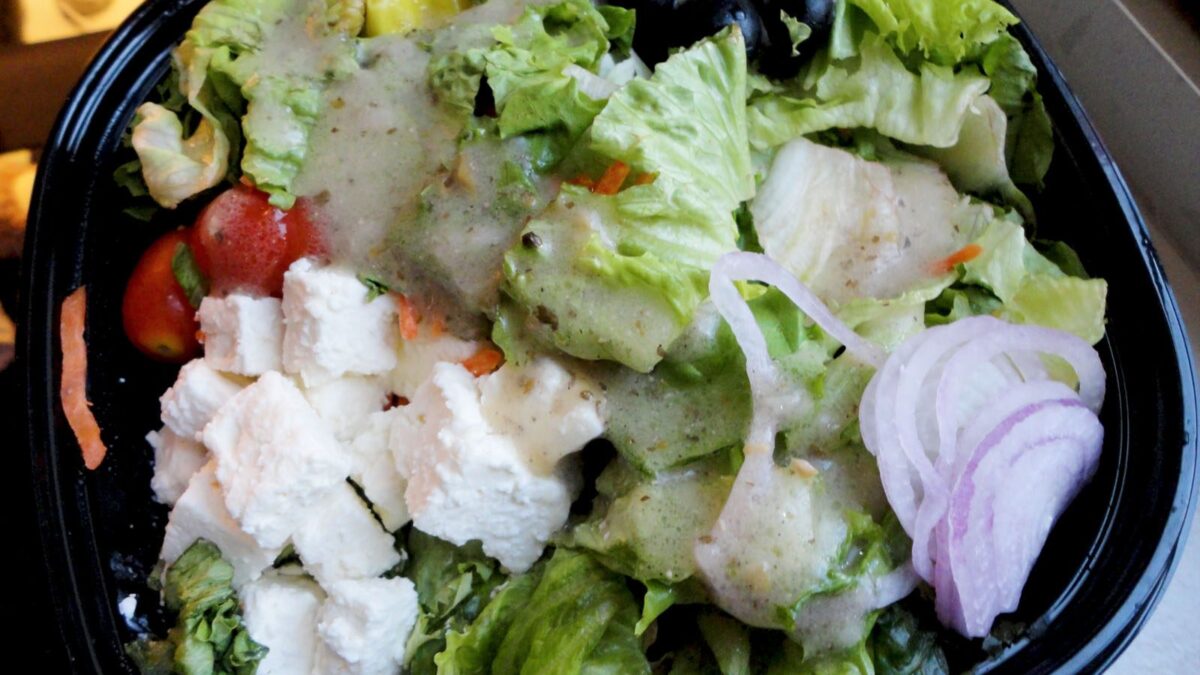
A real Greek salad, the horiatiki you get in a village taverna, has no lettuce in it at all. It is tomatoes, cucumber, green pepper, red onion, olives, a slab of feta, olive oil and dried oregano. That is the entire dish, which is exactly why the quality of each piece matters more here than in almost any other salad.
I have been making this the same way since a trip where I ate it four days running and finally asked the cook what she did differently. Her answer was mostly about salt and timing, and it changed how I build it.
There is no lettuce in horiatiki
The word means village salad, and the version sold in most supermarkets and chain restaurants — shredded romaine at the bottom, everything else scattered over — is a Western adaptation that makes the salad cheaper to serve. Lettuce is bulk. It is also the wrong texture: it goes limp in the dressing within minutes, and it dilutes the tomato juice that is supposed to pool at the bottom of the bowl.
That pooled juice is the point. You mop it with bread. Lettuce absorbs it and gives you nothing back.
If you like lettuce in your salad, have lettuce in your salad. Just know that you are making something else, and that the something else needs a proper vinaigrette because it no longer has tomato juice doing that job.
Tomatoes carry the dish, so buy accordingly
This salad is only as good as its tomatoes and there is no technique that rescues bad ones. In practice that means buying whatever is in season locally rather than whatever is labelled best, and storing them on the counter, never in the fridge. Refrigeration below about 12°C flattens tomato aroma, and it does not come back on the counter.
Look for weight. A tomato that feels heavy for its size has more gel and less air, and it will give you juice instead of pale wedges. Squeeze gently at the shoulder: you want it to yield slightly, not resist like an apple.
Four medium tomatoes, cut into six wedges each, is roughly right for four people as a side. Cut through the pole, not the equator — the wedges hold together better and lose less seed gel to the board.
Salting the tomatoes first
Here is the step almost every recipe skips. Cut your tomato wedges into the serving bowl, sprinkle a generous pinch of flaky salt over them, and leave them for 10 to 15 minutes before anything else goes in.
Two things happen. The salt draws out juice, which becomes the base of your dressing along with the olive oil, so you are not diluting the salad with a separate vinaigrette. And the tomato flesh itself seasons properly instead of tasting bland under a salty exterior. Salt applied at the table only ever reaches the surface.
Do not go past twenty minutes or the wedges start collapsing. I have pushed it to half an hour while distracted and ended up with something closer to a salsa — still edible, not the dish.
Block feta, brine, and why crumbles fall flat
Buy feta as a block sitting in brine, not the pre-crumbled tubs. Crumbled feta is usually dried out and often stabilized with anti-caking agents, and the texture goes chalky instead of creamy. A block in brine stays soft, and the brine itself is useful — a tablespoon of it whisked into the olive oil sharpens the dressing.
Look for Greek feta made with sheep’s milk, or a sheep and goat blend. Cow’s milk versions labelled "feta-style" are firmer, saltier in a one-note way, and they squeak. Real feta crumbles under a fork but stays moist inside. If you would rather the cheese arrived hot, a 20-minute halloumi and couscous salad takes the opposite approach with a squeakier cheese.
Serve it as a slab on top of the salad, not stirred through. That is how it is done, and there is a practical reason: mixed-in feta breaks down into salty grit and its saltiness spreads evenly, which is dull. A slab means every forkful you break off is a distinct hit of cold, creamy cheese against warm tomato.
Drizzle the slab with its own bit of olive oil and a separate pinch of oregano before serving. Six ounces is enough for four; I usually cut it slightly bigger because someone always wants more.
Cucumber: peel, seed, or leave it alone
It depends entirely on which cucumber you have, which is why the blanket advice you find is useless.
Standard supermarket cucumbers with thick, waxy, dark skin: peel them, or at least stripe the skin off with a peeler in alternating bands. That skin is bitter and tough. If the seed core is watery and pale, run a teaspoon down the middle and scoop it out.
Small Persian or Lebanese cucumbers, or a thin-skinned English one: leave the skin on entirely. It has flavor and it holds the slice together.
Cut thick, about one centimetre. Thin slices go floppy in the salt and juice within ten minutes. Half-moons for a standard cucumber, whole rounds for the small ones.
Taking the harshness out of red onion
Raw red onion can dominate everything it touches, and the fix takes five minutes. Slice it as thinly as you can manage, drop the slices into a bowl of cold water, and leave them for 10 minutes. Drain and pat dry.
The water pulls out the sulphur compounds that cause the sharp burn and the aftertaste that lingers for an hour. What is left is the sweetness and the color. I do this every single time now, and the difference is much bigger than five minutes of effort deserves.
Half a medium onion is plenty for four people. Slice it pole to pole rather than across — the slices are firmer and less aggressive that way.
Prep at a glance
| Ingredient | Cut | Prep step that matters | Timing |
|---|---|---|---|
| Tomatoes | 6 wedges each, through the pole | Salt in the bowl first | 10–15 min before serving |
| Cucumber | 1cm half-moons | Peel only if the skin is thick and waxy | Just before assembling |
| Red onion | Thin, pole to pole | Cold water soak, then dry | 10 min soak |
| Green pepper | Thin rings or strips | Remove the white pith, it is bitter | Just before assembling |
| Feta | Left as a slab | Keep it in its brine until the last moment | Add last, on top |
| Olives | Whole, pitted | Rinse if very salty, then dry | Any time |
Ingredients
- 4 ripe tomatoes — cut into wedges; the riper, the better.
- 1 large cucumber — sliced into thick half-moons for crunch.
- 1/2 red onion — thinly sliced, soaked in cold water for 10 minutes.
- 1 green bell pepper — sliced into rings or strips.
- 1/2 cup Kalamata olives — pitted, for classic briny flavor.
- 6 oz block feta cheese — traditionally left in a slab, not crumbled.
- 1/4 cup extra-virgin olive oil — use a good one; it matters here.
- 2 tablespoons red wine vinegar — or fresh lemon juice for brightness.
- 1 teaspoon dried oregano — the signature Greek herb.
- Salt and black pepper — to taste.
Instructions
- Cut the tomatoes into thick wedges and place them in a large serving bowl. Sprinkle with a generous pinch of salt and leave them for 10 to 15 minutes to release their juices.
- While the tomatoes sit, slice the red onion thinly and soak it in a bowl of cold water for 10 minutes. Drain and pat dry.
- Slice the cucumber into thick half-moons, peeling first only if the skin is thick and waxy. Add it to the tomatoes.
- Slice the green pepper into thin rings or strips, discarding the white pith, and add it along with the Kalamata olives and the drained onion.
- In a small jar, whisk together the olive oil, red wine vinegar, oregano and a grind of black pepper until combined.
- Pour the dressing over the vegetables and toss gently to coat, keeping the tomato wedges intact.
- Place the slab of feta on top of the salad rather than mixing it in. Drizzle it with a little extra olive oil and sprinkle with more oregano.
- Let the salad sit for 5 minutes, then serve family-style straight from the bowl, breaking into the feta as you plate each portion.
Olive oil, oregano, and the bread at the bottom of the bowl
A quarter cup of olive oil for four people sounds like a lot if you are used to restrained dressings. It is not a mistake. The oil is a component here, not a coating, and combined with the tomato juice and a spoonful of feta brine it becomes the sauce you finish the meal by mopping up. Use a peppery, green extra-virgin oil if you have one — you will taste it directly, so the cheap neutral bottle is a waste of the dish.
On oregano: dried beats fresh, and this is one of the few herbs where that is true rather than a compromise. Drying concentrates the compounds that give oregano its resiny edge, and fresh oregano leaves taste comparatively grassy and mild against feta. Greek dried oregano sold on the stem is worth seeking out. Crush it between your palms as it goes on to wake it up.
Rub some between your fingers and smell it before using. If it smells like dust, it is more than a year old and it is doing nothing for you.
The bread is not optional in my house. A thick slice, no butter, straight into the bowl at the end. If you want to build a fuller mezze spread around this, hummus and baba ganoush cover the same table without competing, and falafel turns it into a proper meal. Off the grill, marinated beef kebabs are what I put beside it most, because the tomato juice already does a sauce’s job.
How far ahead you can build it
You can do most of the work in advance, just not the final assembly. Cut peppers, soak and drain the onion, and pit the olives up to a day ahead and keep them in separate covered containers in the fridge. Cucumber holds about six hours once cut before it starts weeping.
Tomatoes are the limit. Do not cut them more than about twenty minutes before serving, and do not refrigerate them cut — the cold flattens the flavor and the texture turns mealy. Salting is the only advance step they tolerate, and only within that fifteen-minute window.
Dressed salad does not keep. An hour in and the cucumber is soft, the pepper has lost its snap, and the whole bowl is swimming. If you have leftovers, drain off the liquid, chop everything smaller, add a little more oil, and eat it the next day as a chopped salad on bread with the leftover feta broken through it. That version is genuinely good, which is the only reason I ever over-make it. A caprese salad has the same problem and the same rescue.