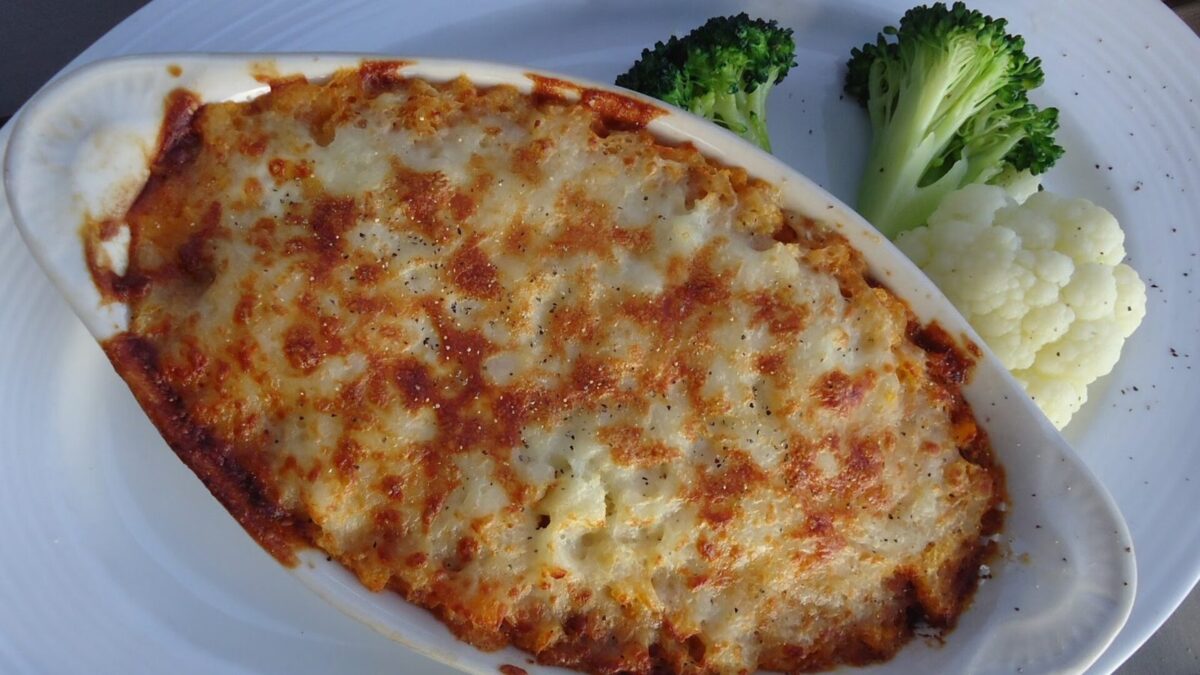
Shepherd’s pie fails in five recognisable ways, and I’ve served all five to people I like. So this one starts with the failures, because knowing which one you had last time tells you exactly which step to change.
Quick point of order before anything else, since it comes up every time: lamb makes it shepherd’s pie, beef makes it cottage pie. Shepherds herd sheep. That’s the whole logic. Both are good, the method below is identical for either, and nobody will refuse the plate over it — but that’s the naming rule and it isn’t a matter of opinion.
Prep: 25 mins Cook: 40 mins Serves: 6
Failure one: filling that floods the plate
You cut a slice, it holds for two seconds, then a grey tide runs out and swamps everything.
Cause: the filling went into the dish too loose. Meat, onion and carrot release water, and a cup of stock on top of that is far more liquid than a tablespoon of flour can hold.
Fix: after the stock goes in, simmer the filling uncovered for a full 8 to 10 minutes, not the 2 minutes most recipes suggest. The test is a wooden spoon dragged across the base of the pan — the channel should stay open for two full seconds before liquid creeps back in. If it closes instantly, keep going. The filling should look slightly too thick in the pan, because it loosens again in the oven.
Failure two: mash that sinks into the meat
You spoon the potato on and it disappears. What comes out of the oven is a single beige mass with no layers.
Cause: hot filling plus soft mash. The mash has no structure to sit on and the filling has no skin.
Fix: two parts. Let the filling stand off the heat for 10 minutes so a slight skin forms and it firms up. Then don’t dollop the mash into the middle — pipe or spoon it around the outer edge first, working inward, so each spoonful is anchored against the rim of the dish and the one before it. Keep the mash on the stiffer side; it should hold a peak when you lift the masher.
Failure three: a greasy orange top
Fat pooling in the corners of the dish and a slick, orange-tinged crust that goes soggy rather than crisp.
Cause: undrained lamb. Ground lamb is fattier than beef and 1.5 pounds of it can render out 4 tablespoons or more.
Fix: brown the meat, then tip the pan and spoon the fat off before the vegetables go in. Leave roughly a tablespoon behind — you want some for the onions and for the flour to bind with. Do not drain after the flour has gone in, because you’ll be removing the thickener along with the fat.
Failure four: gravy that tastes of nothing
Everything is technically correct and the whole thing is flat and brown-tasting.
Cause: no browning and no acid. If the meat went into a pan that wasn’t hot enough, it poached in its own liquid instead of searing, and there’s nothing on the pan base to build on.
Fix: get the pan properly hot, add the meat in two batches rather than one, and don’t touch it for the first 3 minutes so a crust forms. Then tomato paste — 2 tablespoons, cooked in the pan for a full 2 minutes until it darkens from bright red to brick and starts sticking. That colour change is the flavour. Worcestershire sauce adds the sharpness and the anchovy-savoury note; a tablespoon, added with the stock. If it still tastes flat at the end, it’s salt, not seasoning: taste and add more.
Failure five: mash that’s turned to glue
Stretchy, sticky, wallpaper-paste potato that you could hang a picture with.
Cause: overworked starch. Food processors and stick blenders do this instantly. So does mashing potatoes that are waterlogged.
Fix: drain the potatoes properly, then return them to the empty hot pan for 60 seconds so the surface moisture steams off — you’ll see the outsides go chalky. Mash with a hand masher or a ricer, add butter first and warmed milk second (cold milk cools the potato and you end up beating it more to compensate), and stop mixing as soon as it looks smooth. Yukon Gold gives a creamier result; russets go fluffier and are more forgiving. I use Yukon Gold and accept slightly more risk.
Ingredients
- 1.5 pounds ground lamb (or ground beef, for cottage pie)
- 2 pounds potatoes, peeled and cut into even 4 cm chunks (Yukon Gold or russet)
- 4 tablespoons butter, divided
- 1/4 cup milk, warmed
- 1 large onion, finely diced
- 2 medium carrots, diced small
- 1 cup frozen peas
- 2 cloves garlic, minced
- 2 tablespoons tomato paste
- 1 tablespoon Worcestershire sauce
- 1 tablespoon all-purpose flour
- 1 cup beef or chicken stock
- Salt, black pepper, a sprig of fresh thyme
Instructions
- Heat the oven to 200°C / 400°F. Put the potato chunks in cold salted water, bring to a boil, and cook 15 to 18 minutes until a knife slides through with no resistance.
- Drain the potatoes and return them to the empty hot pan for 60 seconds to dry out. Mash with 2 tablespoons butter, then the warmed milk. Season hard — more salt than feels right, since it has to season the filling underneath too.
- Heat the remaining 2 tablespoons butter in a large oven-safe skillet over medium-high. Brown the lamb in two batches, leaving each batch undisturbed for 3 minutes before stirring, 6 to 8 minutes total.
- Tip the pan and spoon off the rendered fat, leaving about a tablespoon.
- Add the onion, carrot and garlic. Cook 5 to 6 minutes until the onion is translucent and the carrot has lost its raw edge.
- Stir in the tomato paste and cook 2 minutes, until it darkens to brick red and catches slightly on the pan.
- Scatter over the flour, stir for 1 minute, then add the stock, Worcestershire sauce and thyme. Simmer uncovered 8 to 10 minutes, until a spoon dragged across the base leaves a channel that holds for two seconds.
- Stir in the frozen peas, taste and adjust the salt, then take the pan off the heat and let it stand 10 minutes.
- Spoon the mash on in blobs around the outer edge first, joining them up as you work inward. Rough the surface with a fork — the raised ridges are what brown.
- Bake 25 to 30 minutes, until the top is golden and the filling bubbles up around the rim. Rest 10 minutes before serving so the filling sets.
Two optional moves, both worth the trouble. Grate 40 g of sharp cheddar over the mash for the last 10 minutes. Not traditional, and it browns far more reliably than plain potato does, especially in an oven that runs cool.
Run the fork ridges in one direction only rather than in a crosshatch. Sounds like nothing. The ridges catch and crisp; a crosshatch mostly makes shallow dents that don’t.
Making it the day before
This is better on day two, and I mean that in a specific way: the gravy sets, the flavours stop tasting like separate ingredients, and it slices cleanly instead of slumping.
Assemble it completely, cool it to room temperature within about two hours, cover and refrigerate. Bake from cold and add 15 minutes to the time — figure 40 to 45 minutes total. The centre should reach 74°C / 165°F. I check with a probe pushed into the middle at an angle, because a straight-down reading catches the mash rather than the filling.
Freezing works, unbaked, up to three months. Thaw fully in the fridge first. Baking from frozen gives you a scorched top over a cold middle and I’ve never got the timing to work.
What goes alongside
Almost nothing needs to. There’s meat, vegetables and potato in every spoonful. A sharp green salad cuts the richness, or buttered peas if you left them out of the filling.
If you’re feeding people who want more on the table, cheesy garlic bread handles the gravy well. And the technique here — brown hard, cook the tomato paste, reduce properly — is the same spine as my beef stew and my slow cooker pot roast. Get it right once and three dinners improve.
One last thing on the mash, since it’s half the dish: if yours comes out well here, the same drying-in-the-pan step is what makes the potato on loaded baked potatoes fluffy rather than dense.