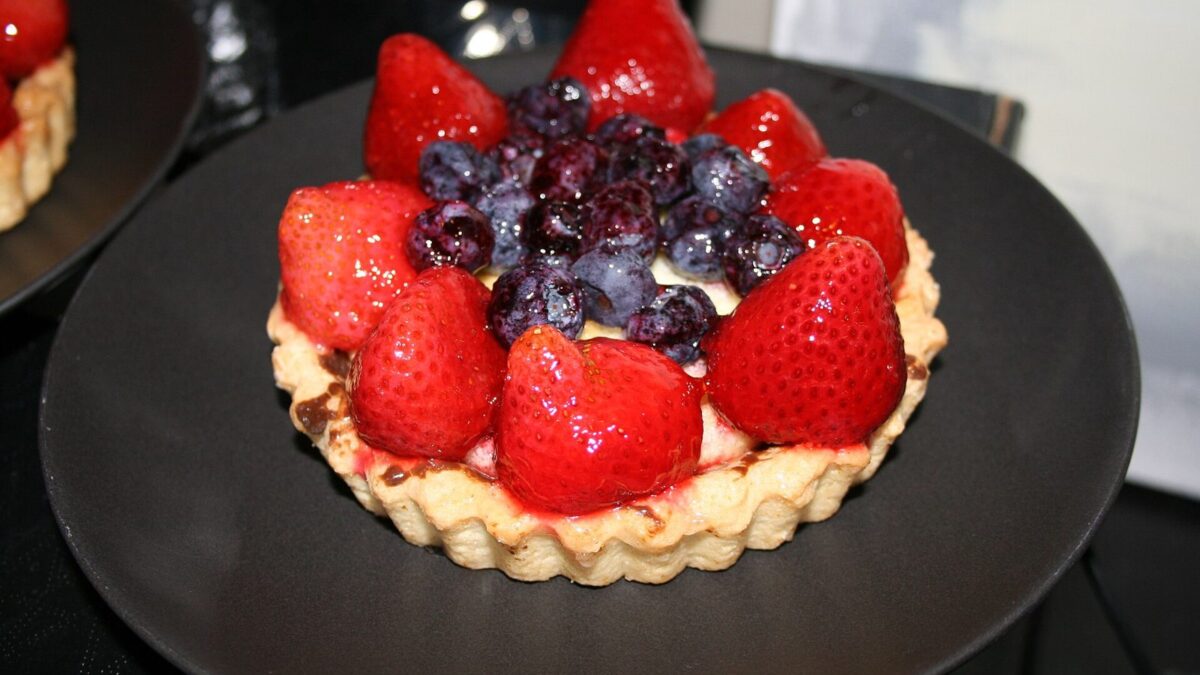
Two questions get asked about fruit tarts more than everything else combined, and they have the same answer underneath: a layer of fat between the pastry and the wet things sitting on it. Here’s the long version of both, then the recipe, then the ones that come up once you’ve made it.
Why Does The Base Go Soggy Under The Cream
Because crème pâtissière is about 80 percent water by weight and shortcrust pastry is thirsty. Starch in the baked crust pulls moisture out of the custard sitting on it, and once those pastry walls soften they never crisp back up. You’ve got roughly 4 hours from assembly before a properly blind-baked shell starts to feel damp underneath, and about 90 minutes if it was underbaked.
Three fixes, in order of how much difference they make:
- Bake the shell further than feels right. Fifteen minutes with weights, then a full 8 to 10 minutes without, until the base itself is a proper golden brown rather than pale. A pale base is a wet base within the hour. This is the one that matters most.
- Seal it. Brush the inside of the hot shell with a thin coat of beaten egg white and put it back in the oven for 2 minutes. It sets into a waterproof film you can’t taste. Melted white chocolate does the same job and tastes of something, which is either an advantage or not.
- Assemble late. The custard can be made 2 days ahead, the shell a day ahead. Bringing them together is a 10-minute job.
I skipped the egg white seal for years because it sounded fussy. It takes two minutes and it’s the difference between a tart that’s still crisp at dinner and one that isn’t.
Can I Build It The Day Before
Not fully assembled. But you can do almost all of it.
How I split it when people are coming: the pastry cream goes into a bowl with plastic wrap pressed flat onto its surface and lives in the fridge up to 2 days, thickening overnight. The blind-baked shell sits at room temperature, uncovered, up to 24 hours. Do not refrigerate the empty shell. Fridges are humid and the pastry goes soft in a way baking won’t undo.
Then on the day: whisk the cold cream smooth, spread, arrange the fruit, glaze. Ten minutes, twelve if you’re being neat with the strawberries. The tart is at its best 1 to 3 hours after assembly, chilled, so you can build it before guests arrive rather than during. Past 6 hours the fruit weeps into the cream and the base gives up. For a dessert you can make two days ahead instead, baklava only improves as the syrup soaks in.
Ingredients
- 1 1/2 cups all-purpose flour
- 1/2 cup powdered sugar
- 1/2 cup cold unsalted butter, cubed
- 1 large egg yolk, plus a splash of cold water
- 2 cups whole milk
- 4 large egg yolks
- 1/2 cup granulated sugar
- 1/4 cup cornstarch
- 2 teaspoons vanilla extract, or the seeds of one vanilla bean
- 3 to 4 cups assorted fresh fruit
- 1/4 cup apricot jam, warmed
Instructions
- Pulse the flour, powdered sugar and cold butter until the mixture looks sandy. Add the egg yolk and a splash of cold water and mix just until it clumps. Press evenly into a 9-inch tart pan and chill 30 minutes.
- Heat the oven to 350°F (175°C). Prick the chilled base all over, line with parchment and pie weights, and bake 15 minutes. Lift out the weights and bake another 8 to 10 minutes, until the base is golden. Cool completely.
- Warm the milk in a saucepan until it steams. In a bowl, whisk the 4 egg yolks, granulated sugar and cornstarch until pale and smooth.
- Pour the hot milk into the yolks in a slow stream, whisking the whole time, then return everything to the pan over medium heat.
- Cook, whisking constantly and getting into the corners of the pan, until the custard thickens and a few bubbles break the surface, about 3 to 4 minutes. Off the heat, stir in the vanilla.
- Scrape into a bowl, press plastic wrap directly onto the surface, and chill until cold and set, at least 2 hours.
- Whisk the cold pastry cream smooth, then spread it evenly into the cooled shell.
- Arrange the fruit on top, packing it fairly tightly, working from the outside in.
- Brush the fruit gently with the warmed apricot jam and chill until you’re ready to serve.
Does The Crème Pâtissière Really Need The Full Two Hours
Yes, and the reason isn’t temperature. It’s the cornstarch.
Cornstarch granules swell and burst as the custard cooks, then their starch chains re-associate as it cools, which is what turns a pourable custard into something that holds a knife cut. That re-linking is slow. At 45 minutes the cream is cold to the touch but still slack and will slump against the pastry wall. At 2 hours it’s set. Overnight it’s firm enough to need a hard 20-second whisk before it spreads, which is normal.
Two things go wrong at the cooking stage. Pulling it off before the bubbles break means the starch hasn’t fully gelatinised, and it will never set no matter how long it chills. Cooking well past that point makes it stringy, because the yolk proteins start to scramble. Watch for the moment it holds a trail from the whisk, give it 30 more seconds, stop.
If yours came out lumpy, push it through a sieve while warm. Nobody will know. The same custard base fills chocolate éclairs, so it’s worth getting comfortable with.
Which Fruit Holds Up And Which Bleeds
Fruit choice is mostly about how much juice it releases once cut.
Reliable: blueberries and raspberries whole, strawberries halved with the cut face down, kiwi in rounds, mandarin segments patted dry, grapes halved, blackberries, figs quartered.
Difficult: anything that browns, so apple, pear and banana need lemon juice and still look tired within the hour. Watermelon and other wet melons leak straight into the cream. Fresh pineapple contains bromelain, an enzyme that breaks down protein, and it will slowly turn the custard’s set to soup; tinned pineapple is heat-treated and doesn’t.
Pat everything dry before it goes on, especially anything rinsed. A wet berry laid on pastry cream leaves a pale halo within twenty minutes. If your stone fruit is too soft to arrange neatly, it’s a better candidate for an almond pear tartlet, where the fruit gets baked in rather than laid on.
What If I Have No Apricot Jam For The Glaze
The glaze isn’t decoration. It’s a seal that keeps air off the cut fruit, and without it the strawberries dull and the kiwi weeps within an hour.
Apricot is the standard because it’s pale, sets firm and tastes of very little. Substitutes that work, in order: warmed and sieved peach or quince jam, redcurrant jelly if you don’t mind a pink cast, or 2 tablespoons of apple juice heated with 1/2 teaspoon of gelatin and cooled to just-warm. Honey thinned with a teaspoon of hot water is the emergency option; it stays tacky rather than setting, but it does the job for a couple of hours.
Warm whichever you use until it’s brushable but not hot, sieve it, and dab it on with a soft pastry brush rather than dragging. Dragging pulls the fruit out of position and smears cream up between the pieces.
And how do I get clean slices out of it?
Chill the assembled tart at least 1 hour, use a thin sharp knife rather than a serrated one, and cut in a single downward press instead of sawing. Wipe the blade between every slice; the glaze drags jam and cream across the next cut.
Push the loose base up out of the ring before you cut, not after, and cut on the metal base rather than transferring the tart to a board. Trying to slide a filled 9-inch tart onto a plate in one piece is how you end up serving it in a bowl. Ask how I know.
Eight slices out of a 9-inch tart is generous, ten more realistic alongside coffee. After a big meal, cut twelve and put a plate of madeleines beside it so people can take a small slice without feeling short-changed. The tart is the better dessert of the two, but a 9-inch apple pie is the one that gets finished.