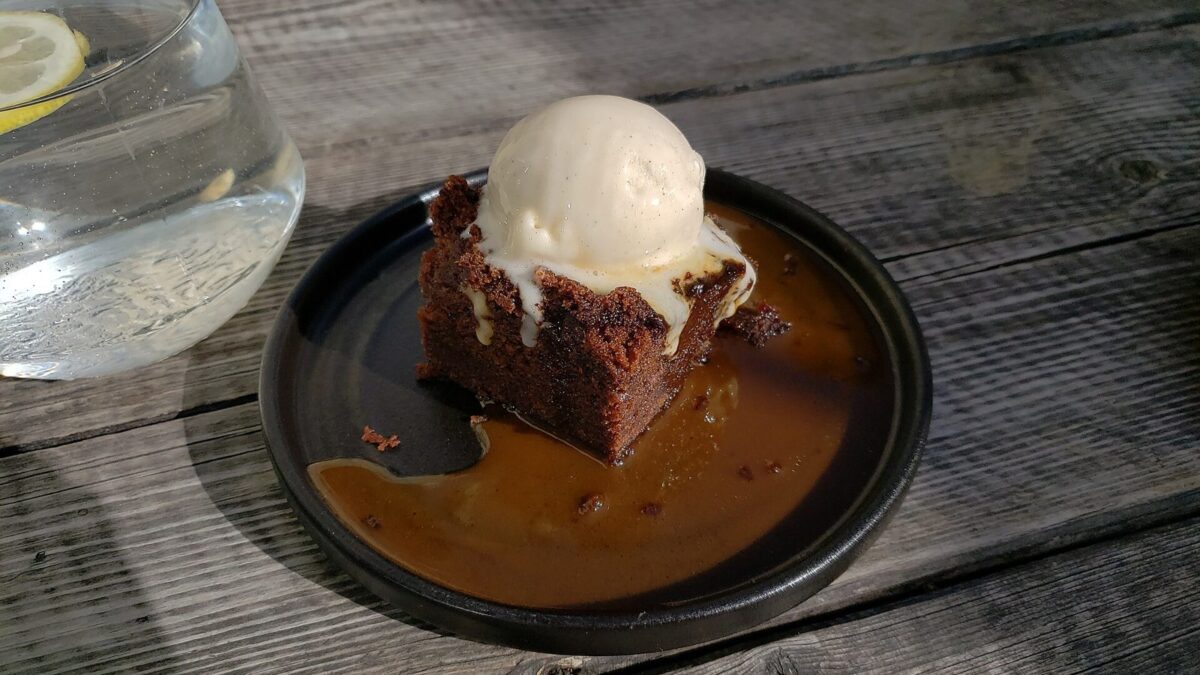
Sticky toffee pudding is a date cake with a caramel sauce poured through it, and almost everything that separates a good one from a dry one happens in the first fifteen minutes, before the mixer comes out.
I make this more than any other dessert in winter, mostly because it reheats better than anything else I know. What follows is the long version: the date and bicarbonate step, both traditional cooking methods, how much sauce to hold back, and how to make it days ahead without apologising for it.
What Actually Makes It Sticky
Not the sauce. The dates.
Dates are roughly two-thirds sugar by weight, mostly glucose and fructose rather than sucrose. Those two are hygroscopic: they pull moisture out of the air and hold onto it. A sponge built on a cup of date purée stays damp on the counter for days in a way a plain butter sponge never does. The sauce adds gloss and salt, but the stickiness is baked in.
It’s also why the pudding is nearly impossible to overbake into dryness, and why it tolerates a second and third reheat. A forgiving dessert wearing the costume of a difficult one.
The Date Purée And The Bicarb Fizz
Chop 1 cup of pitted dates, cover with 1 cup of boiling water, stir in 1 teaspoon of baking soda, and watch it foam.
Two things are happening. The alkali softens the dates’ cell walls chemically, so 15 minutes of soaking does the work an hour of plain water soaking would, and you get a purée that blends smooth instead of stringy. It also raises the pH of the batter, which speeds up browning in the oven and darkens the crumb towards that near-black colour people associate with a good sticky toffee pudding. The foam itself is carbon dioxide coming off the dates’ natural acids meeting the soda.
Get the order right: boiling water onto the dates first, then the soda. Adding soda to cold water does very little, and dumping it into the blender later gives you a soapy note nobody wants. Medjool dates are softer and blend smoother; Deglet Noor are firmer, cheaper, and need the full 15 minutes. Pulse to mostly smooth, leaving a few visible flecks. A completely smooth purée makes a slightly gummy crumb.
Sponge Tin Or Pudding Basin
Two traditional routes, and they produce genuinely different desserts.
The baked sponge, which is what the recipe below does, goes into a 9-inch square dish at 350°F for 30 to 35 minutes. Slightly crisp top, dry surface that takes the first pour of sauce beautifully. It’s the pub version, and it’s what most people picture.
The steamed version goes into a buttered pudding basin, covered with pleated parchment and foil, and sits in a pan of simmering water for about 1 hour 45 minutes. Finer, wetter, more uniform crumb, closer to a Christmas pudding, no crust at all. Better if you’re turning it out whole at the table; worse if you like the contrast between a caramelised top and a soft inside.
I bake it. The crust is half the point, and standing over a steaming pan for two hours is a big ask on a Tuesday.
Ingredients
- 1 cup pitted dates, chopped
- 1 cup boiling water
- 1 teaspoon baking soda
- 6 tablespoons unsalted butter, softened, plus more for the dish
- 2/3 cup granulated sugar
- 2 large eggs, at room temperature
- 1 teaspoon vanilla extract
- 1 1/2 cups all-purpose flour, spooned and levelled
- 1 1/2 teaspoons baking powder
- 1/4 teaspoon salt
- 1 cup heavy cream, divided between the sauce and serving
- 1 cup packed dark brown sugar
- 4 tablespoons unsalted butter, for the sauce
Instructions
- Heat the oven to 350°F and butter a 9-inch square baking dish, or line an 8-cup dish with parchment.
- Put the chopped dates in a heatproof bowl, pour over the boiling water, then stir in the baking soda. It will foam. Leave it 15 minutes.
- Tip the dates and all their liquid into a blender or processor and pulse until mostly smooth, with a few small pieces left.
- Beat the softened butter and granulated sugar until light and fluffy, about 2 minutes. Add the eggs one at a time, beating well after each, then the vanilla.
- Whisk the flour, baking powder and salt together. Fold into the butter mixture in two additions, alternating with the date purée, until just combined. Stop as soon as the flour disappears.
- Pour into the dish, smooth the top, and bake 30 to 35 minutes, until a toothpick comes out clean and the top springs back.
- While it bakes, make the sauce: put the brown sugar, 4 tablespoons butter and 3/4 cup of the heavy cream in a small pan over medium heat. Boil gently, whisking often, for 3 to 4 minutes until slightly thickened and glossy.
- The moment the cake comes out, poke holes all over the top with a skewer and pour about a third of the warm sauce over it.
- Rest 10 minutes so the sauce sinks in, then slice and serve warm with the rest of the sauce and a splash of the reserved cream.
The Toffee Sauce, And How Much To Hold Back
A third onto the hot cake, two thirds at the table. That split matters more than it sounds.
The first pour goes on while the sponge is still above 150°F and its structure is open, so it travels down through the skewer holes and disappears. Pour the whole batch on at that point and you get a sweet, saturated cake with nothing to spoon over the plate, and the bottom turns to syrup. Hold two thirds back, keep it warm, and every serving gets a fresh pour that sits on the surface and runs down the sides.
On the sauce itself: dark brown sugar, not light. The molasses is where the bitterness comes from, and without it the sauce is just sweet. Boil it gently for 3 to 4 minutes and no longer. At 5 minutes it starts to thicken past pourable and sets to a chewy caramel when it cools, which is a fine thing to eat with a spoon but wrong here. A quarter teaspoon of flaky salt whisked in at the end is the one change I make to the classic every single time.
If the sauce splits and goes greasy, take it off the heat and whisk in a tablespoon of cold cream. It comes back together nearly every time.
Individual Puddings Versus One Big Traybake
Individual puddings in a greased muffin tin or dariole moulds bake in 18 to 22 minutes and give a much higher ratio of caramelised surface to crumb. They turn out onto plates, they look like something, and each one soaks its own sauce. Fill the moulds two-thirds full and no further; this batter rises more than you’d expect.
The traybake wins on effort and on reheating. One dish, one bake, and you cut what you need and leave the rest intact, which matters because every cut face is a face that dries out. For a crowd I do the traybake. For anything I want to look considered, individual moulds, made in the morning so they only need warming.
Timings By Format
| Format | Tin | Temperature | Time |
|---|---|---|---|
| Traybake | 9-inch square | 350°F | 30 to 35 min |
| Individual | 12-hole muffin tin | 350°F | 18 to 22 min |
| Dariole moulds | 6 x 150ml | 350°F | 22 to 25 min |
| Steamed basin | 1.2 litre basin | Simmering water | 1 hr 45 min |
The toothpick test beats all of these. Individual puddings in particular go from perfect to slightly tight in about three minutes, so check at 18.
Making It Days Ahead
This is the dessert’s real advantage over almost anything else you’d serve warm. Bake the sponge, skip the first sauce pour entirely, cool it, and wrap the dish tightly. It sits happily at room temperature for 2 days or in the fridge for 4.
Make the sauce separately and keep it in a jar in the fridge, where it lasts a week and sets to something like soft fudge. It loosens back to pouring consistency over low heat in about 3 minutes, or 40 seconds in the microwave with a stir halfway.
This is better than baking on the day, not just easier. The date sponge is more moist on day two, for the reason at the top: those sugars keep pulling water back into the crumb overnight. Unlike a peach cobbler, best within an hour of the oven, this one improves in the wait.
Reheating Without Drying It Out
Cover it. That’s most of the advice.
For a whole traybake: 325°F, foil over the dish, 15 to 20 minutes from room temperature or 25 from cold. For single portions: plate, a spoonful of sauce over the top, cover loosely, microwave 30 to 40 seconds. The sauce on top is doing the work, keeping the surface from going leathery while the middle warms.
Uncovered in a hot oven the cut edges harden into something closer to a biscuit within 10 minutes. I have served that. It was fine with enough cream, but it wasn’t right.
Freezing, Both Halves
The sponge freezes well for 3 months. Cool it fully, cut it into portions before freezing rather than after, wrap each in plastic then foil. Portions thaw in about 2 hours at room temperature and can go straight from frozen into a 325°F oven, covered, for 25 to 30 minutes.
The sauce freezes too, and I’d say it comes back better than most caramels because of the dairy. Freeze it in a tub, thaw overnight in the fridge, then warm gently and whisk. It’ll look separated when it first melts. Keep whisking.
What doesn’t work: freezing the sponge with the sauce already soaked in. The sugar keeps it from freezing solid and the texture on thawing is unpleasantly wet.
Questions People Ask Me About Sticky Toffee Pudding
Can I use another dried fruit instead of dates?
Prunes come closest and I’d use them without hesitation, same weight, same soak. Figs work but the seeds are noticeable. Raisins do not; they’re too low in moisture and the sponge comes out dry and oddly fruity. At that point you’re making something closer to bread pudding.
Why did my pudding sink in the middle?
Almost always overmixing after the flour goes in, or opening the oven before 25 minutes. The batter is wetter than a standard cake batter and its structure sets late.
Is it meant to be served with cream or ice cream?
Pouring cream, cold, straight from the jug. Ice cream is good but it melts into the sauce and you lose the temperature contrast within a minute. If you want the frozen route, serve it the way you’d serve a molten chocolate lava cake, with the scoop on the side of the plate rather than on top.
Can I halve the sugar?
In the sponge, you can drop the granulated sugar to 1/2 cup and it still works; the dates carry plenty. In the sauce, no. The sugar is what makes it a toffee sauce rather than sweetened cream.
Why is my sauce grainy?
Sugar crystals that never dissolved. Whisk over lower heat for longer before it comes to the boil, and don’t scrape the sides of the pan down into the sauce once it’s boiling.
Does it work in a 9×13 dish?
Yes, but the sponge comes out about an inch thick and bakes in 22 to 25 minutes. Check early. You’ll also want to increase the sauce by half, because there’s more surface area per portion. For a thinner set dessert with the same make-ahead advantage, a crème brûlée is the better use of a big flat dish.