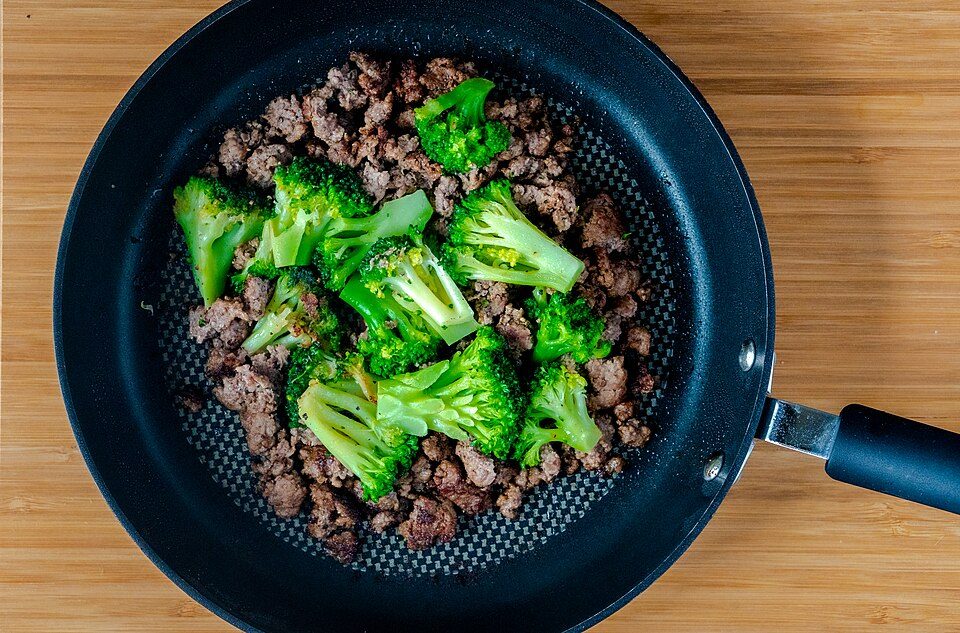
Beef and broccoli goes wrong in exactly two places, and neither of them is the sauce. The beef is either chewy or grey, and usually both. Fix the cut-and-coat and fix the pan heat, and the rest of this dish is a fifteen-minute job you can do on a Tuesday.
Two Things Decide Whether This Works
First: slice the flank across the grain, thin, and toss it in cornflour before it meets the pan. That cornflour coat is a stripped-down version of what Chinese kitchens call velveting. It holds a little moisture against the surface of the meat and gives the sauce something to cling to at the end. A tablespoon over a pound of sliced beef is plenty. The same cornflour-and-soy coating carries a black pepper chicken that cooks in 20 minutes.
Second: the pan has to be genuinely hot. Not warm. Hot enough that a drop of water skitters and vanishes in about a second. Beef laid into a lukewarm pan releases its juice, sits in it, and poaches to a uniform grey — you can watch a pool of liquid form within about twenty seconds, and once that happens there’s no recovering it in that batch.
Everything else here is assembly.
Ingredients
- 1 pound flank or sirloin steak, thinly sliced against the grain
- 1 tablespoon cornstarch, for coating the beef
- 4 cups broccoli florets
- 3 tablespoons soy sauce
- 2 tablespoons oyster sauce
- 1 tablespoon brown sugar
- 1 teaspoon sesame oil
- 1 tablespoon cornstarch, for the sauce
- 1/2 cup beef broth or water
- 3 cloves garlic, minced
- 1 tablespoon fresh ginger, grated
- 2 tablespoons vegetable oil
- Cooked rice, to serve
Instructions
- Pat the sliced beef properly dry with kitchen paper, then toss it with 1 tablespoon of cornstarch until every piece has a faint dusty film. Leave it while you do the rest.
- Whisk the soy sauce, oyster sauce, brown sugar, sesame oil, the second tablespoon of cornstarch, and the broth together until no lumps remain. Set it by the stove.
- Heat 1 tablespoon of oil in a large skillet or wok over high heat until it shimmers and moves like water. Add half the beef in a single layer and leave it completely alone for 60 seconds, then toss for another 30 to 45. Remove to a plate and repeat with the rest. Two batches, not one.
- Add the remaining oil and the broccoli. Stir-fry 2 minutes, throw in 2 tablespoons of water, cover for 60 to 90 seconds, and let the steam finish it to bright green and tender-crisp.
- Push the broccoli aside, add the garlic and ginger to the bare patch, and stir for 30 seconds until you can smell them.
- Return the beef and any juices on the plate, whisk the sauce once more (the cornstarch settles fast), and pour it in. Toss for 1 to 2 minutes until it thickens and coats everything glossily.
- Serve straight over hot rice, with the pan juices spooned over.
Slicing Across the Grain, Concretely
Look at the surface of the flank steak and you’ll see fibres running in one direction, like the grain in a plank. Your knife goes at 90 degrees to those lines. Cut with the grain instead and every slice is a bundle of long intact fibres, which is what chewy means.
Aim for about 3mm. Thinner than you think. The reliable trick is 20 minutes in the freezer first — the steak firms up just enough that the knife stops dragging, and I get slices half the thickness of what I manage with room-temperature meat. Flank has the clearest grain of the cheap cuts, which is why I keep buying it over sirloin even though sirloin is more forgiving.
If Your Beef Came Out Grey
It was one of three things, in this order of likelihood.
The pan wasn’t hot enough. The beef went in wet. Or you cooked all of it at once. That last one catches people who own a small 24cm skillet and follow a recipe written for a wok: a pound of beef in one layer needs roughly 28cm of floor space, and squeezing it in drops the pan temperature far enough that you’re back to poaching.
If you’ve only got the small pan, do three batches instead of two. It costs you four extra minutes and it’s the difference between browned edges and boiled meat.
Broccoli has its own tell: once it goes from bright green to olive, it’s overcooked and no amount of sauce brings it back. I pull it a shade before it looks done, because it keeps cooking in the residual heat while the sauce thickens. Same instinct applies in classic vegetable stir-fry, where the timing gap between crisp and limp is even narrower. Leftover rice from a previous night is the right base here, and if you’ve got extra it turns into vegetable fried rice or 15-minute shrimp fried rice the next day without complaint. For a bigger rice-bowl evening, korean beef bibimbap uses the same across-the-grain slicing on the same cut.