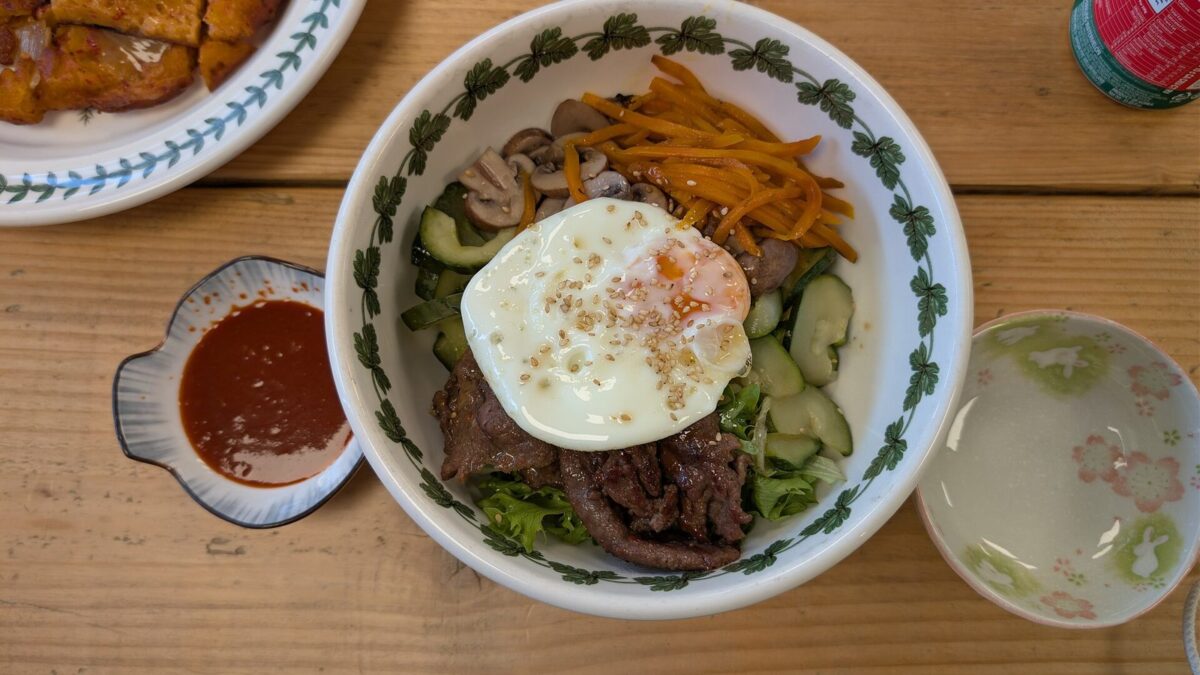
Bibimbap is a Korean rice bowl — the name translates roughly as “mixed rice” — and the single component people underrate is the rice itself. Not the sauce, not the beef. The rice.
In a restaurant it arrives in a dolsot, a heavy stone bowl heated until it’s genuinely dangerous to touch, and the layer of rice pressed against the sides crisps into a golden sheet called nurungji while you’re eating. That crackle against the soft vegetables is most of what makes the dish memorable. I don’t own a dolsot. I’ve made this maybe thirty times in a 26 cm cast-iron skillet, and I get close enough that I stopped wanting one.
Prep: 25 mins Cook: 25 mins Serves: 4
Getting a crisp rice base without a stone bowl
The mechanism is simple: dry heat, a thin fat film, and time without stirring. Short-grain rice has the surface starch to form a crust; long-grain basmati mostly won’t, and I’ve tried.
My method: heat the cast-iron dry over medium for 4 minutes, add 2 teaspoons of neutral oil and half a teaspoon of sesame oil, then press about 4 cups of warm cooked short-grain rice into an even layer roughly 2 cm thick. Then leave it alone for 5 to 7 minutes. You’ll hear it before you see it — a fine, continuous ticking, not a sizzle. When the ticking starts to slow down, slide a thin spatula under one edge. If it lifts as a sheet rather than as loose grains, it’s done.
Two things ruin this. Freshly cooked rice that’s still steaming is too wet, so day-old refrigerated rice actually works better here, same as it does for vegetable fried rice. And a non-stick pan can’t hold enough dry heat at a safe temperature; every attempt I’ve made in non-stick gave me warm rice and no crust.
Why each vegetable gets seasoned on its own
The seasoned vegetable components are called namul, and cooking them separately isn’t fussiness for its own sake. Each one needs a different amount of water removed and a different amount of salt to taste of anything.
Spinach holds an enormous amount of water. Blanch it 30 seconds, plunge it into cold water, then wring it in your hands like a wet flannel — you’ll be shocked how much comes out, easily a quarter cup from 2 cups of leaves. Season it after squeezing, or the salt drains away with the water.
Bean sprouts need 1 minute in boiling water and no more; at 2 minutes they go soft and lose the snap that’s their entire contribution.
Carrot is the opposite problem. Julienned carrot is dense and barely gives up any water, so it wants 2 minutes in a hot dry-ish pan with a pinch of salt to soften slightly while staying firm.
Zucchini sits in the middle: salt it, wait 10 minutes, pat it dry, then a fast 2-minute sauté. Skip the salting step and it releases water into the finished bowl, which is how you end up with a soupy base and no crust at all.
If you cooked all four together in one pan, the spinach would overcook while the carrot was still raw, and everything would be seasoned to the same flat note. That’s the whole argument. It takes about 12 extra minutes and it’s the difference between a bibimbap and a mixed vegetable bowl.
The gochujang sauce, by ratio
I keep this in my head as a 3:1:1:1 — 3 tablespoons gochujang, 1 tablespoon each of sesame oil, sugar and water, plus 1 tablespoon rice vinegar and a clove of minced garlic. Gochujang out of the tub is thick enough to hold a spoon upright and far too concentrated to distribute through rice, so the water and oil are structural, not decorative.
Brands vary a lot in heat. The two I buy locally differ by maybe double in chili strength, so I mix the sauce, taste it on a spoonful of plain rice rather than on its own, and adjust from there. Tasting neat gochujang sauce tells you almost nothing about how it’ll land in the bowl.
Make it 20 minutes ahead if you can. The garlic’s raw edge softens and the sugar dissolves properly.
Marinating and slicing the beef
This is a bulgogi-style marinade: soy sauce, sesame oil, sugar, garlic. The sugar matters more than it looks — it’s what gives the beef those dark caramelised edges in a hot pan in under 2 minutes.
Slicing is where home cooks lose it. You want pieces about 3 mm thick, cut across the grain, and that’s close to impossible with soft raw ribeye. Put the beef in the freezer for 45 to 60 minutes first, until it’s firm at the edges and still yielding at the centre when you press it. Then it slices cleanly against a sharp knife.
Find the grain before you start — look for the parallel lines running through the muscle, and cut at 90 degrees to them. Cutting with the grain gives you long fibres and chewy beef no marinade can rescue. Sirloin works fine and costs less than ribeye; I use it most weeks.
Fifteen minutes in the marinade is a genuine minimum, 30 is better, and past about 4 hours the soy starts to cure the surface and the texture goes slightly firm and hammy.
The order to cook things in
Nine components and one cook is a timing problem, and the first few times I made this half the bowl was lukewarm.
What works: cook the rice the day before, or at minimum an hour ahead so it can cool. Marinate the beef, then do all the vegetables while it sits — they’re fine at room temperature and nobody eats namul piping hot anyway. Only then start the rice crust, because that’s the 7-minute window everything else has to fit around. Sear the beef and fry the eggs during those 7 minutes; both are fast enough. Same logic as building shrimp fried rice, where the rice has to be cold and ready before the pan gets hot.
Ingredients
- 1 pound beef ribeye or sirloin, part-frozen then sliced 3 mm across the grain
- 3 tablespoons soy sauce, divided
- 2 tablespoons sesame oil, divided
- 2 teaspoons sugar, for the marinade
- 3 cloves garlic, minced and divided
- 4 cups cooked short-grain rice, ideally cooked the day before
- 2 cups fresh spinach
- 1 cup bean sprouts
- 1 medium carrot, julienned
- 1 medium zucchini, julienned
- 4 large eggs
- 3 tablespoons gochujang
- 1 tablespoon rice vinegar
- 1 tablespoon sugar and 1 tablespoon water, for the sauce
- Neutral oil for cooking, toasted sesame seeds, salt
Instructions
- Combine the sliced beef with 2 tablespoons soy sauce, 1 tablespoon sesame oil, the 2 teaspoons sugar and half the garlic. Leave it 15 to 30 minutes.
- Mix the sauce: gochujang, rice vinegar, remaining 1 tablespoon soy sauce, 1 tablespoon sesame oil, 1 tablespoon sugar, 1 tablespoon water and the remaining garlic. Set aside.
- Toss the julienned zucchini with a good pinch of salt and leave it 10 minutes, then pat dry.
- Blanch the spinach 30 seconds, cool it in cold water, and wring it out hard. Season with a pinch of salt and a few drops of sesame oil.
- Blanch the bean sprouts 1 minute, drain, and season the same way.
- Sauté the carrot 2 minutes with a pinch of salt, then the zucchini 2 minutes. Keep each one in its own pile.
- Sear the beef in a very hot pan in two batches, 90 seconds to 2 minutes per batch. Crowding it steams it grey.
- Fry the eggs in a little oil until the whites are set and the yolks still run, about 3 minutes.
- Heat a 26 cm cast-iron skillet dry over medium for 4 minutes. Add 2 teaspoons neutral oil plus 1/2 teaspoon sesame oil, press the rice in evenly, and leave it undisturbed 5 to 7 minutes until a spatula lifts a whole sheet.
- Arrange the vegetables and beef in separate wedges over the rice, set an egg in the middle, scatter sesame seeds, and serve the sauce alongside.
Serve it in the pan, not in bowls
If you’ve bothered with the crisp base, moving the rice to individual bowls destroys it. I bring the skillet to the table on a wooden board and let people scoop from it. It stays hot enough to keep crisping for another five minutes, which people notice.
Warn everyone the pan handle is around 200°C. I say this from experience.
Mixing it properly
Bibimbap is meant to be stirred thoroughly before eating, not picked at wedge by wedge. Add the sauce, break the yolk, and mix everything until the rice is evenly coloured. The arrangement is for the moment it hits the table, not for eating from.
Start with less sauce than you think. Two tablespoons per bowl is plenty, and you can always add.
A note on where this dish comes from
Bibimbap is Korean, it’s eaten across Korea, and the dolsot version is particularly associated with Jeonju. I’m a home cook in a home kitchen, not an authority on Korean cuisine, and what I’ve written here is how I make it after reading around and cooking it repeatedly — not a claim about the definitive version. If you have a Korean grocer near you, ask them which gochujang they use at home. That single question improved my sauce more than anything I worked out on my own.
Swaps I’ve tested, and one that failed
Mushrooms sliced and browned hard are an excellent fifth vegetable. Shiitake especially. Cucumber, salted and squeezed like the zucchini, works raw and adds a cold crunch.
Brown rice does not form a crust. I tried it twice, hoping. Skip it.
For a meat-free version, firm tofu pressed 20 minutes and pan-fried in the same marinade holds up genuinely well, and the bowl loses less than you’d expect. If that’s the direction you’re headed, the pepper and cabbage handling in my vegetable stir-fry transfers straight over.
And if this bowl becomes a habit, the same part-frozen slicing trick is the one thing that most improves beef and broccoli stir-fry — thin, even, across the grain, seared fast in batches. Different sauce, identical knife work.