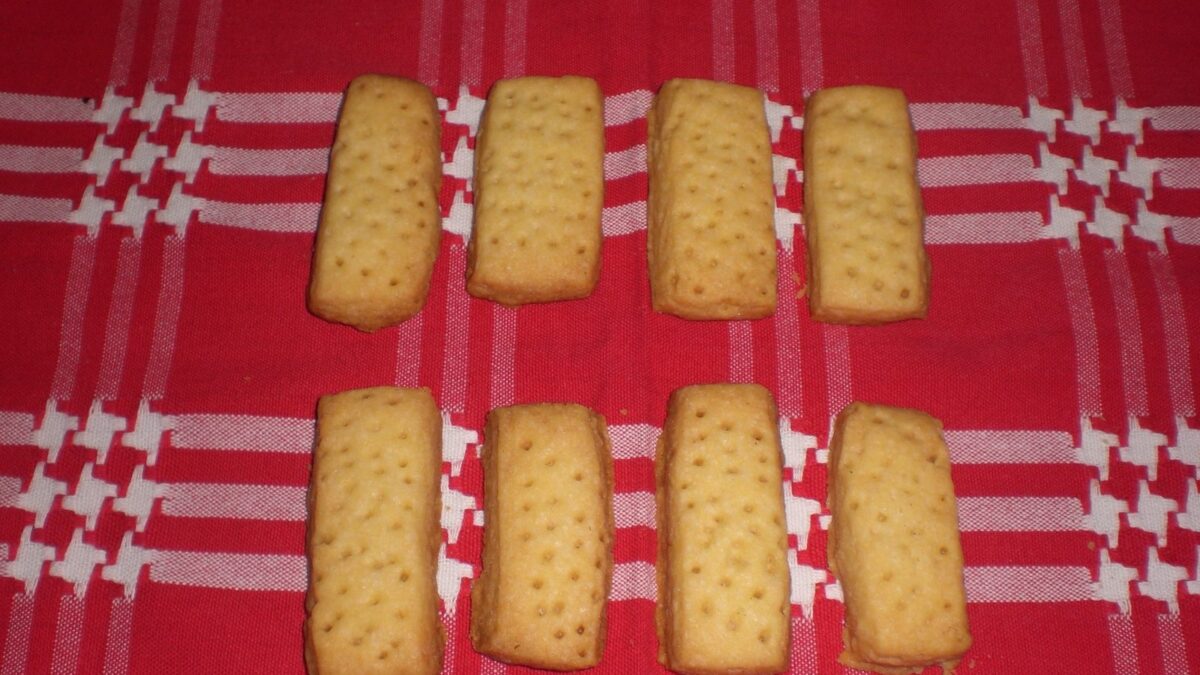
There are two shortbreads worth arguing about, and the argument is really about texture. One is flour and butter and sugar, nothing else. The other cuts some of the flour with cornstarch, which the British call cornflour, or with rice flour. They taste nearly identical. They feel completely different in the mouth, and that’s the whole decision.
What each version is actually doing
Shortbread has no eggs, no liquid and no leavening. The only structure comes from gluten forming when flour meets the small amount of moisture in the butter, and butter is only about 16 to 18 percent water, so there isn’t much to work with. That’s the point. Gluten is the enemy here.
Cornstarch has no gluten-forming protein at all. Swapping 2 tablespoons of the flour for cornstarch dilutes the protein, so less gluten forms, so the cookie collapses into powder faster on the tongue. Rice flour does something different: it’s also gluten-free but its granules are gritty and don’t fully dissolve, which gives you a faint sandy bite that traditional Scottish shortbread is known for.
All-butter keeps every bit of what protein there is, so the cookie holds together more and gives a cleaner snap when you break it.
Side by side
| All-butter (2 cups flour) | With cornstarch (2 cups flour, 2 tbsp cornstarch) | |
|---|---|---|
| Snap | Clean, audible break | Softer, crumbles rather than snaps |
| Mouthfeel | Dense, buttery, slight chew at the centre | Melting, powdery, dissolves fast |
| Edge definition | Holds a cut edge and a fork prick well | Edges soften slightly, fine detail blurs |
| Best shape | Fingers, rounds, anything stamped | Thick squares and petticoat wedges |
| Bake at 325°F, 1/3 inch | 16 to 18 minutes | 15 to 17 minutes, watch from 14 |
| Handles warm kitchens | Better | Worse, goes fragile |
The case for leaving the cornstarch out
If you’re cutting shapes, stamping a pattern, or dipping half of each cookie in chocolate, go all-butter. The extra structure is what stops a stamped thistle from turning into a vague dent by minute twelve. I made the same batch both ways on a February afternoon, cut both into 2-inch rounds, and the cornstarch ones lost their fork holes almost entirely.
All-butter also travels. I’ve posted a tin of it and had it arrive intact. The cornstarch version breaks in transit, which I learned the expensive way.
The case for putting it in
The melt is genuinely better. Bite an all-butter cookie and you chew it; bite the cornstarch version and it goes to nothing against the roof of your mouth in about two seconds. With a cup of tea, that’s the more pleasurable cookie by some distance.
It also forgives a slightly heavy hand. If you tend to work the dough too long, and most of us do, the cornstarch buys you back some of the tenderness you kneaded out.
Which one I actually bake
The cornstarch version, at 2 tablespoons, and I’ll defend it against anyone who says it isn’t proper shortbread. Two tablespoons across 2 cups of flour is about a 6 percent swap, which is small enough that the butter flavour is untouched and large enough that you can feel it. Going to 1/4 cup, which some recipes do, is where it starts tasting slightly chalky and the cookie gets too fragile to lift.
The exception is Christmas, when I want stamped shapes that survive a tin, and then I leave it out entirely.
What settled it for me was baking both and leaving them out for a week. Sunday afternoon, two trays, same butter, same 325°F oven, cut into identical 2-inch rounds so nobody could tell which was which. Everyone who tried both picked the cornstarch one, and the all-butter tray was still half full on Thursday. That isn’t a controlled test and I’m not pretending it is, but seven days is a long time for a cookie to sit uneaten in my house.
Ingredients
- 1 cup unsalted butter, softened — roughly 65°F, dents under a finger but isn’t greasy. This is most of the flavour, so use good butter.
- 1/2 cup powdered sugar — finer crumb than granulated, which stays slightly crunchy.
- 2 cups all-purpose flour — spooned and levelled.
- 1/4 teaspoon fine salt
- 1 teaspoon pure vanilla extract
- 2 tablespoons cornstarch (optional) — leave it out for snap, put it in for melt.
- Flaky sea salt (optional), for the tops.
- Granulated sugar (optional), for rolling the edges.
Instructions
- In a large bowl, beat the softened butter and powdered sugar with a wooden spoon or hand mixer until pale, smooth and creamy, about 2 minutes.
- Beat in the vanilla until fully combined.
- In a separate bowl, whisk together the flour, cornstarch if using, and salt. Add to the butter mixture in two additions, mixing gently just until a soft dough forms. Stop the moment it comes together.
- Turn the dough out onto a lightly floured surface, pat it into a disc, wrap it and chill at least 30 minutes so the butter firms and the flour hydrates.
- Preheat the oven to 325°F (165°C) and line two baking sheets with parchment. Roll the chilled dough to about 1/3 inch thick and cut into rounds, squares or fingers.
- Space the cookies about an inch apart. Prick each a couple of times with a fork, and sprinkle with flaky salt or sugar if you like.
- Bake 16 to 18 minutes, until the edges are just barely golden. Shortbread should stay pale, so pull them the moment the edges take colour.
- Cool on the pan 10 minutes before moving to a wire rack. They firm up as they cool.
Thickness changes the answer
At 1/3 inch, either version works. Go thicker, to the 1/2 inch a proper petticoat tail wants, and the cornstarch version is clearly better, because a thick all-butter cookie can be genuinely hard work to bite. Go thinner, to 1/4 inch for a crisp wafer, and drop the cornstarch entirely or the cookies will break when you lift them off the tray.
Thickness also changes the bake. Add about 3 minutes at 1/2 inch, take about 3 off at 1/4 inch, and judge by the edges rather than the clock.
Where rice flour comes in
Replace 1/4 cup of the all-purpose flour with fine rice flour and you get the third option: a distinct sandy grain, drier than either of the others, and the closest thing to the shortbread sold in the tartan tins. I like it, though I’d call it an acquired texture. Coarse rice flour is a mistake here; it reads as under-mixed rather than deliberate.
You can combine rice flour and cornstarch, but keep the total non-wheat flour under about 1/3 cup or the dough stops holding together at all. I’ve pushed past that and ended up patting crumbs into a tin like a cheesecake base.
Keeping and freezing
Baked shortbread keeps in an airtight tin for two weeks and is arguably better on day three, once the butter flavour has settled. Keep it away from anything strongly spiced. A tin of shortbread stored next to classic gingerbread cookies picks up the cloves within a day, which I discovered in the worst way one December.
The dough freezes better than the cookies do. Roll it into a 2-inch log, wrap tightly, and freeze up to 3 months; slice straight from frozen into 1/3-inch coins and add 2 minutes to the bake. That’s how I keep something bakeable in the house at all times, the same trick I use with peanut butter cookies.
One last idea for a batch of the all-butter version: bake the offcuts thin, crush them, and use them as the base for a tart shell. And if you like the plain-butter-and-flour end of baking, blueberry scones and classic oatmeal raisin cookies sit on the same shelf of my recipe box for a reason.