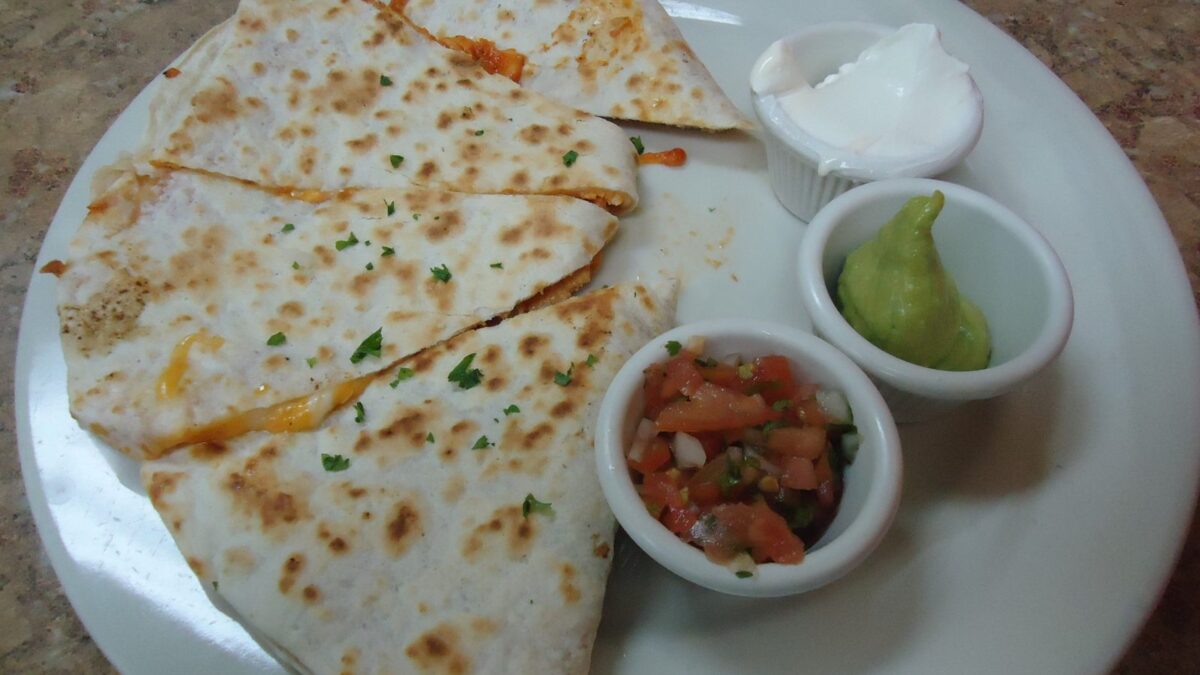
A quesadilla is five decisions, and most recipes only tell you the answers they happen to like. Dry pan or fat in the pan. Folded or stacked. Flour or corn. Cheese as glue or cheese as the whole point. One skillet or a sheet pan when there are six of you.
I’ve cooked these most weeks for about nine years, usually on a Tuesday with whatever chicken survived Sunday. Here’s how each choice actually shakes out, with a winner named in every case, then the recipe built from the winners.
Prep: 10 mins Cook: 12 mins Serves: 4
Dry Pan vs Buttered Pan vs Oiled Pan
Dry pan first, because it’s the one people are most surprised by. A flour tortilla already carries fat, usually 3 to 4g per 20cm tortilla, and in a dry pan over medium heat that fat is enough to blister and crisp it in about 2 minutes a side. The result is dry-crisp, like a cracker. It stays crisp longest. It also tastes plainest.
Butter browns beautifully, since its milk solids colour at a far lower temperature than oil does, so you get colour before the cheese melts. That’s the trap. Butter’s smoke point sits around 150°C, and on a pan hot enough to crisp a tortilla it goes from golden to speckled black in maybe 40 seconds. I’ve burned more of these than I care to count.
Oil, a neutral one, holds up to the heat, browns evenly, and gives a slightly fried edge. It’s also the greasiest of the three if you’re heavy-handed.
Winner: dry pan, with a thin smear of oil on the pan and none on the tortilla. Roughly half a teaspoon, wiped around with kitchen paper. You get browning without the greasy underside, and the tortilla stays crisp for the twenty minutes it takes everyone to sit down. If you want the butter flavour, brush a little melted butter on after it comes out of the pan. Same taste, none of the burning.
Folded Half-Moon vs Two-Tortilla Stack
The fold is one tortilla closed over its filling. The stack is two tortillas with filling between them, like a sandwich.
The fold is easier to flip, uses half the tortillas, and the hinge holds everything in so almost nothing escapes into the pan. The downside is the filling sits in a wedge, thick at the fold and thin at the edge, so some bites are all cheese and some are all bread.
The stack spreads the filling evenly and cuts into neater wedges. It’s also unstable. Flipping a loaded stack needs a wide spatula and a bit of nerve, and the top tortilla likes to slide off at the halfway point.
Winner: the fold, for anything cooked in a pan. The stack wins only on a sheet pan, where you’re not flipping anything at all.
Flour vs Corn Tortillas Here
Corn tortillas taste better. The flavour has a depth flour doesn’t. For this dish they still lose.
Corn tortillas have no gluten, so they don’t stretch, and a cold one folded in half cracks straight down the crease. They’re also smaller, usually 12 to 15cm against 20 to 25cm for burrito-size flour, which means less room for filling and more fiddling. You can make corn work: warm each one for 20 seconds a side on a dry pan first, until it’s pliable, then fold. It’s an extra step per quesadilla and I skip it on a weeknight.
Winner: flour, 20cm, for this recipe. If you want corn’s flavour without the cracking, use two small corn tortillas as a stack rather than folding one, or put the corn where it belongs and make ground beef tacos instead.
Cheese as Glue vs Cheese Plus Filling
Cheese-only quesadillas melt into one clean layer and never fall apart. They’re also a bit boring after two.
The problem with loading them up is structural. Cheese is the only thing holding the tortilla shut, so every gram of chicken and pepper you add is a gram pushing the layers apart. Overfill and it splits in the pan, leaks, and the escaped cheese burns onto the surface.
The ratio I’ve settled on, per 20cm tortilla: 60g grated cheese, 50g chicken, 20g diced vegetables. Roughly 5mm total thickness before you fold. Crucially, the cheese goes down in two layers, half against the tortilla and half over the filling, so both faces are glued.
Winner: cheese plus filling, at about 60/40 by weight. Skip the cheese-only version unless you’re feeding a four-year-old, in which case it’s undefeated.
On the cheese itself: cheddar has the flavour, Monterey Jack has the stretch, and a 50/50 mix beats either alone. Grate it from a block. Pre-shredded cheese is coated in potato starch to stop it clumping, and that coating makes the melt slightly claggy instead of smooth.
One Skillet vs a Sheet Pan for a Crowd
A skillet does one at a time, about 5 minutes each including the flip. For four people eating two each, that’s forty minutes and you eat last. I know, having spent plenty of them at the hob while everyone else ate.
The sheet pan version: lay four tortillas on an oiled 30x40cm tray, fill them, top each with a second tortilla, brush the tops with oil, and bake at 220°C (425°F) for 10 minutes, pressing them flat with a second tray for the first 5. Four quesadillas at once, no flipping, and everyone eats together.
The trade-off is real: oven ones are crisp on the two flat faces and soft at the edges, where a skillet gives an even blistered crust all over. The skillet version is better food.
Winner: skillet for up to three people, sheet pan for four or more. Feeding a bigger group than that, I’d honestly make loaded beef nachos and stop pretending.
The Five Calls, Side by Side
| Decision | Winner | Why the other option loses |
|---|---|---|
| Pan fat | Dry pan, thin oil smear | Butter burns near 150°C; heavy oil goes greasy |
| Shape | Folded half-moon | Stacks slide apart mid-flip |
| Tortilla | Flour, 20cm | Cold corn cracks at the fold, no gluten |
| Filling | 60g cheese, 70g filling | Cheese-only gets dull; overfilled ones split |
| Batch of 4+ | Sheet pan, 220°C, 10 min | Skillet takes 5 min each and you eat last |
Leftover Chicken vs Cooking It Fresh
Leftover roast or rotisserie chicken wins on flavour and effort, no contest. It’s already seasoned, already browned, and it shreds into strands that pack flat.
Fresh breast takes 12 minutes longer and tastes blander, but it’s juicier and you control the seasoning. Dice it small (1.5cm), cook over medium-high until the thickest piece reads 74°C / 165°F on a probe thermometer, then rest it 5 minutes before it goes near a tortilla. Skip the rest and the juice runs into the cheese and steams the tortilla soft from inside. The same seasoning and the same temperature rule cover chicken fajitas, which is what I make with the other half of the pepper.
Dry leftover chicken needs help. A tablespoon of salsa or soured cream stirred through 300g of shredded meat brings it back.
Ingredients
- 300g cooked chicken, shredded (about 2 cups)
- 1 tsp chilli powder
- 1/2 tsp ground cumin
- 1/2 tsp garlic powder
- 1 tbsp salsa or soured cream, if the chicken is dry
- Salt and black pepper
- 8 flour tortillas, 20cm
- 250g cheese, half mature cheddar and half Monterey Jack, grated from blocks
- 1/2 red pepper, finely diced
- 3 spring onions, thinly sliced
- 1 tsp neutral oil for the pan
- Salsa, soured cream and lime wedges to serve
Instructions
- Toss the chicken with the chilli powder, cumin, garlic powder, salt and pepper. Add the salsa if it looks dry.
- Grate the cheese and put the pepper and spring onions in separate bowls. Once the pan is hot you won’t have time to chop.
- Heat a heavy skillet over medium for 2 minutes. Add the oil and wipe it around with kitchen paper so only a film is left.
- Lay a tortilla in the pan. Scatter 30g of cheese over one half, then a quarter of the chicken, pepper and spring onion, then another 30g of cheese on top.
- Fold the bare half over and press with a spatula for about 10 seconds. Cook 2 to 3 minutes until the underside is patched with brown.
- Flip with a wide spatula and cook the second side 2 minutes. The cheese at the open edge should be visibly molten.
- Move it to a board and wait a full minute before cutting. Cut it hot and the cheese runs straight out.
- Cut into three wedges with a pizza wheel. Repeat, wiping the pan with kitchen paper between quesadillas to lift any burnt cheese.
Holding Them Without Losing the Crust
Stacking finished quesadillas on a plate is how you undo all that work. Steam gets trapped between them and the crust turns leathery in about four minutes.
Put them on a wire rack over a baking tray in the oven at 95°C (200°F), in a single layer, not touching. Air moves underneath and they hold their crust for a good 25 minutes. A rack over an open tray beats a covered dish every time, and it’s the single thing that most improved my quesadillas.
Dips That Actually Earn a Bowl
Soured cream and shop salsa are fine. They’re also doing nothing the quesadilla can’t do alone.
What changes the plate is acid against all that fat. Lime wedges, squeezed at the table rather than in the kitchen, are the cheapest upgrade going. A proper classic guacamole is next, better made 20 minutes ahead so the onion softens in the lime. Pickled red onions need half an hour: one sliced onion, the juice of two limes, a teaspoon of salt, in a jar on the counter.
The one thing I’d skip: a heavy cheese dip alongside. You’ve already got 60g of cheese inside. Adding more just flattens the whole plate into one note, and I say that as someone who once served both and watched a full bowl go back to the fridge untouched.