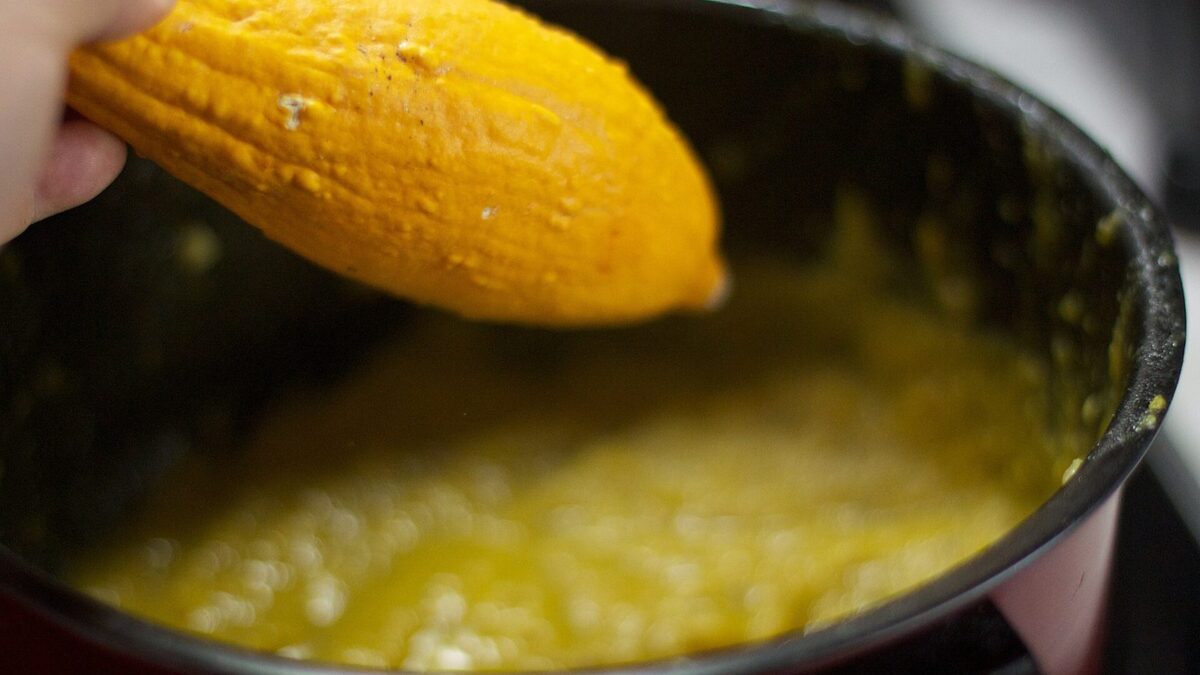
Roasted butternut squash soup fails in about five recognisable ways, and I’ve managed all of them. Before the recipe, here’s each one with what causes it, because knowing which mistake you made last time is more useful than another list of ingredients.
Prep: 20 mins · Cook: 45 mins · Serves 6
It Tastes Like Nothing
The most common failure, and it’s almost always temperature.
Squash roasted at 350°F comes out cooked but pale. At 400°F (200°C) it comes out with browned, shrunken edges, and those edges are where the flavour lives. Surface sugars caramelise from around 320°F; below that you’re only softening it. If your cubes came out the colour they went in, that’s your bland soup, and salt at the end won’t retrofit it.
Second cause: a crowded tray. Three pounds of cubed squash plus a quartered onion needs a full half-sheet pan in a single layer with visible gaps. Piled up it steams, and you get boiled squash that happened to be in an oven.
Third: under-salting during roasting. A teaspoon tossed with the raw cubes seasons them from the outside in over 35 minutes. The same teaspoon stirred into finished soup tastes flat and saline. Season at both stages.
The Texture Is Stringy or Grainy
Stringiness comes from the squash, not from you. The fibrous strands cluster in the seed cavity, and older or larger squash carry more. When you scoop the seeds, take an extra half-inch of flesh with them — the neck is solid, dense and almost string-free, which is why it’s the better part.
Graininess is a blending problem. An immersion blender chops in a small zone and leaves a fine sandy texture however long you run it. A countertop blender at high speed for 60 seconds is a different result; I’ve done both back to back from the same pot and the difference is obvious on the spoon.
Still not smooth? Push it through a sieve. Four minutes, and it’s the same trick that makes a good creamy tomato soup feel like it came from a restaurant kitchen.
It’s Sweet Like a Dessert
Butternut varies enormously. One from October storage, properly cured, can be twice as sweet as a squash picked early, and the recipe doesn’t know which one you bought.
So treat the maple syrup as a rescue tool, not an ingredient. Taste the roasted squash straight off the tray. If it’s already candy-sweet, skip the syrup and cut the cinnamon to a quarter teaspoon.
To pull a too-sweet soup back, in the order I’d try: a tablespoon of cider vinegar or lemon juice off the heat, then more salt, then a pinch of cayenne. Extra broth dilutes the sweetness too, but you lose body. Don’t reach for that first.
The Cream Split Into Specks
You added it too hot, or boiled it after.
Heavy cream survives a simmer, but butternut soup is acidic enough that a rolling boil breaks the emulsion, and broken doesn’t un-break. Pull the pot off the heat, let it settle a minute until it stops bubbling, then stir the cream in and never boil it again. Coconut milk is more fragile still, so add that at the very end off the burner.
Freezing? Freeze before the cream goes in. Dairy frozen and thawed inside a puree comes back slightly grainy, every time.
There’s a Scorched Layer on the Pot Bottom
Pureed soup is thick, and thick soup doesn’t convect. The bottom sits against the metal while the top sits still, and you find out when you scrape and bring up brown flecks that taste bitter through the whole pot.
Three defences: a heavy-based pot rather than a thin one, heat no higher than medium-low once it’s blended, and a flat-ended spatula dragged across the base every couple of minutes rather than a ladle stirred through the middle.
If it’s already caught, stop stirring and ladle the soup into a clean pot without touching the bottom. Whatever’s stuck stays stuck and the rest is usually fine. Scrape, and you spread the burnt flavour through six servings.
Roasting Temperature Is the Whole Game
Everything above traces back to one decision, so here it is precisely. 400°F (200°C) for 30 to 35 minutes. Cubes around 1 inch, tossed in 2 tablespoons of oil, stirred once halfway. You want deep golden edges, a few genuinely dark spots, and cubes that collapse slightly under a fork.
Push to 425°F and pull at 25 minutes when time is short; more colour, slightly less even cooking, and I don’t mind the trade. What I wouldn’t do is drop to 375°F to play safe. Safe here means pale, and pale means the soup you’ll be seasoning desperately at the end.
Roast the onion and garlic on the same tray, garlic still in its skin — naked cloves burn bitter in 15 minutes at this heat, wrapped ones turn sweet and squeeze out like paste.
Ingredients
- 1 large butternut squash, about 3 pounds — peeled, seeded, and cubed
- 1 medium onion, quartered — roasts alongside the squash
- 3 garlic cloves, unpeeled — roasting mellows their sharpness
- 3 tablespoons olive oil, divided — for roasting and sautéing
- 1 teaspoon salt, plus more to taste — season at the tray and at the pot
- 1/2 teaspoon ground cinnamon — enhances the squash’s natural sweetness
- 1/4 teaspoon ground nutmeg — a warm, cozy background note
- 1 carrot, chopped — for a touch more sweetness
- 4 cups vegetable broth — or chicken broth if not keeping it vegetarian
- 1/2 cup heavy cream or coconut milk — optional, for richness
- 1 tablespoon maple syrup — optional, only if the roasted squash tastes flat
- Pumpkin seeds or croutons, for topping — for crunch
Instructions
- Preheat the oven to 400°F (200°C) and line a large baking sheet with parchment.
- Toss the cubed squash, onion, and unpeeled garlic cloves with 2 tablespoons of olive oil, the salt, cinnamon, and nutmeg. Spread in a single layer with gaps between the pieces. Use two trays if it looks crowded.
- Roast for 30 to 35 minutes, stirring once halfway, until the edges are deeply golden and a cube collapses under a fork.
- Taste a piece of squash off the tray. Note how sweet it is; that decides whether the maple syrup goes in later.
- Meanwhile, heat the remaining tablespoon of olive oil in a large heavy-based pot over medium heat. Add the chopped carrot and cook 5 minutes until slightly softened.
- Squeeze the roasted garlic out of its skins and add it to the pot along with the squash and onion, scraping in any browned bits from the parchment.
- Pour in the vegetable broth, bring to a gentle simmer, and cook 10 minutes.
- Blend until completely smooth — a countertop blender at high speed for 60 seconds gives the silkiest result. Fill it no more than halfway with hot soup and vent the lid, holding a folded tea towel over the top.
- Return to the pot over medium-low heat. Taste, adjust the salt, and add the maple syrup only if it needs it.
- Take the pot off the heat, wait a minute until it stops bubbling, then stir in the cream. Do not let it boil after this point.
- Ladle into bowls and top with pumpkin seeds or croutons.
Blending Without Wearing the Soup
Hot liquid in a sealed blender is genuinely dangerous. Steam expands, pressure builds, and the lid leaves at speed carrying a litre of 90°C puree with it. I’ve cleaned squash soup off a kitchen ceiling exactly once and that was enough.
The rules are short. Never more than half full. Take the small centre cap out of the lid. Cover the hole with a folded tea towel and hold it down. Start on the lowest speed for five seconds, then climb. Letting the soup sit off the heat for ten minutes first helps more than people expect.
Freezing It Properly
It freezes better than most soups, with the cream caveat above. Cool it fully first, then portion into airtight containers leaving about an inch of headspace because it expands. Three months is comfortable.
Thaw overnight in the fridge and reheat on medium-low, whisking briefly as it comes back together; the separation on thawing looks alarming and disappears with stirring. It thickens noticeably in the freezer, so keep a little broth handy.
Still Stuck? Quick Answers
Can I skip roasting and just simmer the squash?
You can, and you’ll get a decent soup that tastes mostly of broth and cinnamon. If time is the problem, cube it smaller and roast at 425°F for 22 minutes instead.
My peeler won’t get through the skin.
Microwave the whole squash 2 minutes, or slice off both ends and stand it upright to cut the skin away with a knife. A sharp Y-peeler handles it; a straight swivel peeler usually doesn’t.
Is it vegan?
With vegetable broth and coconut milk instead of cream, yes. That’s a genuinely good version rather than a compromise, though it adds a faint coconut note.
What goes with it?
A proper grilled cheese for dipping, or a tray of roasted vegetables if the oven’s already at 400°F. And creamy mushroom soup uses browning the same way this one uses roasting.