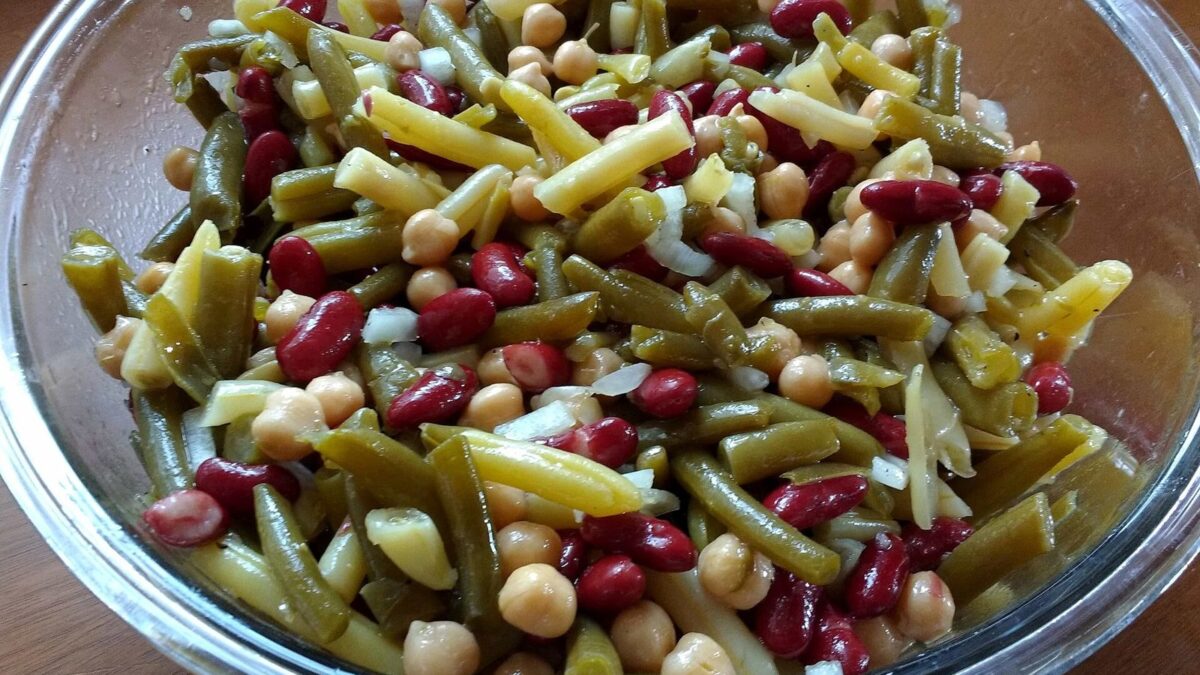
Everything good about three bean salad happens in the dressing, and almost everything people get wrong happens there too. The beans are just beans. What you’re really making is a cold marinade, then letting it work.
So: the ratio, why it needs hours rather than minutes, what changes when you cook your own beans instead of opening cans, and why the rinsing step people treat as optional isn’t.
Prep: 20 mins · Cook: 5 mins · Chill: 2 hours minimum · Serves 8
Start With the Dressing, Not the Beans
The classic American potluck version runs on a simple frame: 2/3 cup vinegar, 1/2 cup granulated sugar, 1/3 cup neutral oil, 1 teaspoon salt, 1/2 teaspoon black pepper. That’s it. No mustard, no garlic, no herbs beyond a little parsley at the end.
Notice what’s odd about it: twice as much vinegar as oil. A standard vinaigrette runs the other way, three parts oil to one. The inversion is the whole point. This dressing isn’t coating leaves, it’s penetrating beans, and it has to be aggressive enough to season the inside of a kidney bean overnight. Make it at vinaigrette strength and you get bland beans sitting in oil.
The oil’s job is mostly carrying flavour and stopping the whole thing tasting purely acidic. Use something neutral. I tried it once with a peppery extra-virgin olive oil I was fond of and the oil won the argument.
The Sweet-Sour Ratio, and How Far You Can Push It
Half a cup of sugar against 2/3 cup of vinegar sounds alarming written down. In the bowl it isn’t sweet, it’s balanced, because 2/3 cup of 5 percent acidity vinegar is harsh on its own.
The range I’ve actually tested, over a few summers of taking this to things:
- 1/2 cup sugar (the original) — sweet-and-sour, the flavour most people recognise. Disappears fastest at a barbecue.
- 1/3 cup sugar — my everyday version. Still balanced, more pickle than dessert. Go here if anything else on the plate is sweet-glazed.
- 1/4 cup sugar — sharp. Good with rich food, but people reach for the water.
- Below 1/4 cup — the acid stops being pleasant and the salad tastes unfinished.
If you drop the sugar, drop the vinegar a little too, or switch to apple cider vinegar, which reads gentler at the same acidity thanks to its own fruit sweetness. Cutting sugar alone while keeping 2/3 cup of white vinegar is the most common way people wreck this salad. Honey and maple work as swaps, roughly tablespoon for tablespoon by volume, but they dissolve into cold vinegar no more easily than sugar does. Which brings me to the annoying bit.
Getting Half a Cup of Sugar to Actually Dissolve
Most recipes, including the one I’ve been making for years, say “whisk until the sugar is fully dissolved.” Try that in cold vinegar and you’ll whisk four minutes and still feel grit at the bottom of the bowl. Cold liquid dissolves sugar slowly, and 2/3 cup of vinegar is not much liquid for 1/2 cup of sugar.
Undissolved sugar isn’t harmless. It settles, so the top of your salad is sour and the bottom is sweet, and you find out at the table.
Two reliable fixes:
- Warm it. Vinegar, sugar, salt and pepper in a small saucepan over low heat, stirring 2 to 3 minutes until you can’t feel any grain when you drag the spoon across the base. Off the heat before it simmers — boiling sharpens the vinegar and reduces the volume. Cool to room temperature, then whisk in the oil.
- Shake it. Everything into a jam jar with a tight lid, shake hard 45 seconds, rest 5 minutes, shake again. Agitation does what patience can’t. This is what I use when I can’t be bothered with a pan.
Check by tilting the jar against the light. If there’s a sandy layer sliding around the bottom, keep going.
Canned or Dried: An Honest Comparison
I use cans, and I’ll say that before the rest, because I’ve made it both ways enough times to think dried beans don’t improve this particular salad much.
Texture is the real gap. Canned kidney beans are cooked to a soft, slightly mealy point that suits a salad fine but never has bite. Home-cooked ones keep a distinct skin and a creamy centre that survives two days of marinating. Making it to sit in the fridge for four days? Home-cooked wins clearly.
Timings, if you go that route. Dried kidney beans: soak 8 hours or overnight, drain, then boil hard for at least 10 minutes before simmering 45 to 60. That hard boil isn’t optional — raw and undercooked red kidney beans contain phytohaemagglutinin, a natural toxin the vigorous boil destroys, and a slow cooker alone doesn’t always get hot enough. Chickpeas: same soak, then 60 to 90 minutes at a bare simmer depending on their age. Salt the cooking water; the old claim that salt toughens skins doesn’t hold up.
Cost. Dried is roughly a third of the price by cooked weight and about ten hours of calendar time. Canned is two minutes with a tin opener.
Dried pays off when the beans are the texture story, the way they are in a properly smooth hummus. In a heavily dressed cold salad, the vinegar does most of the talking.
Why Rinsing and Draining Isn’t Optional
The liquid in a bean can — aquafaba, if you’ve met it in vegan baking — is starchy, salty and slightly metallic. Tip it into the bowl and the starch clouds the dressing into something slick and gluey, the salt stacks on top of the teaspoon you already added where you can’t take it back out, and the tinned flavour gets locked in by the marinade instead of washed away.
Rinse in a colander under cold running water a good 30 seconds per can, moving the beans with your hand, until the water runs clear rather than foamy. Then — the part people rush — leave them draining a full 5 minutes, shaking the colander a few times. Wet beans dilute the dressing, and no amount of extra chilling fixes a weak dressing.
Same for the blanched green beans. Straight out of the ice bath they hold water in every crevice. Spread them on a tea towel and pat.
Ingredients
- 8 ounces fresh green beans, trimmed and halved — blanched for a bit of crunch
- 15 ounces canned kidney beans, drained and rinsed — for heartiness
- 15 ounces canned garbanzo beans (chickpeas), drained and rinsed — adds a nutty bite
- 1/2 cup red onion, thinly sliced — for sharp, colorful crunch
- 1/2 cup red or green bell pepper, diced — optional, for extra color
- 2/3 cup white vinegar or apple cider vinegar — the tangy backbone of the dressing
- 1/2 cup granulated sugar — balances the vinegar’s sharpness
- 1/3 cup olive oil or vegetable oil — use a neutral one, not a peppery extra-virgin
- 1 teaspoon salt — for seasoning
- 1/2 teaspoon black pepper — freshly cracked, if possible
- 1 tablespoon fresh parsley, chopped — optional, for freshness
Instructions
- Bring a pot of salted water to a boil. Add the green beans and cook for 3 minutes, until bright green and just tender-crisp.
- Drain and plunge the green beans straight into a bowl of ice water to stop the cooking and hold the colour. Drain again, then spread on a tea towel and pat dry.
- Rinse the kidney beans and garbanzo beans in a colander under cold water for 30 seconds each, until the water runs clear. Leave them to drain a full 5 minutes.
- Combine the vinegar, sugar, salt, and pepper in a small saucepan over low heat. Stir for 2 to 3 minutes until you can’t feel any grain against the base of the pan. Don’t let it simmer. Remove from the heat and cool to room temperature, then whisk in the oil. (Jar-and-shake method works too: shake hard 45 seconds, rest 5 minutes, shake again.)
- In a large mixing bowl, combine the green beans, kidney beans, garbanzo beans, red onion, and bell pepper if using.
- Pour the cooled dressing over the beans and toss thoroughly so everything is coated. The bowl will look over-dressed. It should.
- Cover and refrigerate at least 2 hours, ideally overnight, stirring once or twice as it chills.
- Before serving, stir well from the bottom, taste, adjust salt, and scatter over the parsley.
How Long the Marinade Really Needs
Two hours is the floor and it’s a compromise. The dressing coats everything and the onion has softened, but the beans still taste like beans sitting in vinegar.
Between 8 and 24 hours it changes character. The acid works into the beans rather than around them, the raw bite leaves the red onion completely, and the bowl tastes like one thing instead of several. If you’ve only eaten this made an hour before a barbecue, you haven’t really eaten it.
Past about three days it’s still sound — the vinegar keeps it safe in an airtight container for a week — but the green beans give up their crunch and look drab. That’s the clock that matters, not safety.
Stir from the bottom before serving, every time. A salad that looks dry on top is usually sitting in half a cup of vinaigrette you haven’t found yet.
Things People Ask Me After the Potluck
Frozen green beans instead of fresh?
Fine. Blanch 1 to 2 minutes rather than 3, since freezing partly cooks them, then ice bath as usual. They’ll be softer. Nobody has ever noticed at a table.
Can I add a fourth bean?
Cannellini or black beans are the obvious ones. Keep total bean volume roughly where it is or the dressing stretches thin. Cannellini also carry a canned tuna and white bean salad if you want the same cupboard trick as a main. Up by a full can means about a third more of each dressing ingredient.
It went slimy. What happened?
Nearly always inadequate rinsing, leaving can starch in the bowl. Occasionally beans that weren’t drained and watered the dressing down past the point where it could work.
What do I serve it with?
It’s built for barbecue plates, next to creamy coleslaw where the vinegar cuts the mayonnaise. It also works as the cold, sharp element beside smoky black bean and sweet potato tacos, or on a mezze-style spread with Greek salad and warm flatbread.