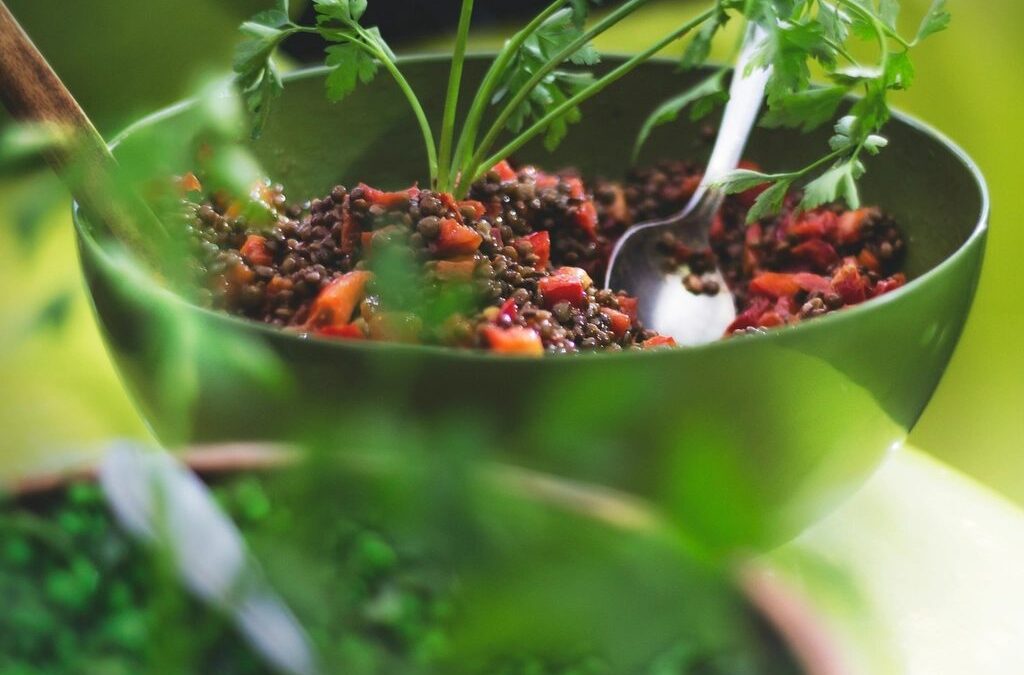
I get more questions about this bowl than about anything else I cook, and nearly all of them are one of three: why aren’t my chickpeas crunchy, why has my dressing turned to water, and can I make it on Sunday for Wednesday. So this one is written as answers.
What actually makes a bowl a “buddha bowl”?
Nothing formal, which is worth saying plainly because the name implies a rulebook that doesn’t exist. It’s a composed bowl: grain base, something roasted, something raw, a sauce, a crunchy thing on top, arranged in visible sections rather than stirred together. The term spread through food blogs and cafe menus in the mid-2010s and has no traditional origin anyone can point to.
The sections are the one part of the idea that’s genuinely useful. Pile everything in and stir and you get a salad where every mouthful is identical. Keep the components in their own quadrant and you can build each forkful differently, which is also why the dressing goes on last and only over the top.
Five components, each doing a different job: soft grain, sweet roasted vegetable, savoury crisp protein, raw leaves, and a sauce with acid in it. Drop one and the bowl goes flat.
How do I get chickpeas genuinely crisp?
Two things, and the second is the one nobody tells you.
First, dry them properly. Tip the drained tin onto a tea towel, fold it over, roll them about for a minute. Loose skins come away and you can pick those out. Water left on the surface has to boil off before browning starts, so a wet chickpea at 220C spends its first eight minutes steaming.
Second, and this is where most recipes fall short, mine included until I fixed it: 22 minutes gets you golden chickpeas, not crisp ones. Crisp needs 30 to 35 at 220C. Red peppers are finished long before that, so if everything goes on the tray together you have to pick one. Give the chickpeas a 10-minute head start alone, then add the peppers, and both come out right.
The test is audible. Shake the tray and properly crisp chickpeas rattle like gravel; if they thud, give them five more minutes. Season before roasting, not after, because the oil carries the paprika onto the surface and it toasts there.
Ingredients
- 1 can (15 oz) chickpeas, drained and patted very dry
- 2 red bell peppers, cut into wide strips
- 2 tablespoons olive oil, divided
- 1 teaspoon smoked paprika
- 1/2 teaspoon ground cumin
- 1/4 teaspoon garlic powder
- Salt and black pepper to taste
- 1 cup dry quinoa or brown rice (about 3 cups cooked)
- 2 large handfuls baby spinach or chopped kale
- 1/2 avocado, sliced (optional)
- Tahini sauce: 3 tablespoons tahini, juice of 1 lemon, 1 small grated garlic clove, 2 to 4 tablespoons water
- To finish: pumpkin seeds, fresh parsley, a pinch of chili flakes
Instructions
- Heat the oven to 425F (220C) and start your quinoa or rice so it’s ready when the tray comes out.
- Dry the chickpeas thoroughly in a tea towel, rolling them to shed the loose skins. This is the single biggest factor in whether they crisp.
- Toss the chickpeas with 1 tablespoon of the oil, the smoked paprika, cumin, garlic powder, salt and pepper until evenly coated. Spread them over one half of a large sheet pan and roast for 10 minutes on their own.
- Toss the pepper strips with the remaining oil and a pinch of salt. Pull the tray out and add them to the empty half, keeping the two in separate zones so neither steams the other.
- Roast for a further 22 to 25 minutes, shaking the pan once, until the chickpeas rattle when you shake the tray and the peppers are collapsed with charred edges.
- While they roast, whisk the tahini, lemon juice and grated garlic in a bowl. It will seize into a thick paste and look ruined. Keep going.
- Whisk in water a tablespoon at a time until it turns pale, smooth and pourable, usually 3 to 4 tablespoons. Season with salt and taste.
- Build each bowl: grains at the base, a handful of raw leaves, then the peppers, chickpeas and avocado in their own sections.
- Spoon the tahini over the top, scatter with pumpkin seeds, parsley and chili flakes, and eat while the chickpeas still have their edge.
Which grain holds up best for meal prep?
Between the two in the recipe, brown rice, by a clear margin. It’s the one that still has chew on day three. Quinoa is better on day one and turns slightly claggy by day two as the grains keep drinking moisture from everything around them.
Farro and pearl barley beat both for this specific job: they hold shape for four days and have enough texture to stand up to a heavy dressing. Barley takes about 30 minutes, pearled farro closer to 25. Couscous is the one to avoid, fluffy and defenceless against a wet dressing, though it’s fine if you’re eating within the hour.
Whatever you cook, spread it on a tray to cool instead of leaving it in the pot. Grain cooling under a lid keeps steaming itself, goes sticky, and compacts into a brick in a lunchbox.
How do I stop the dressing going watery?
Watery tahini almost always means too much water added too fast.
Tahini seizes when the lemon juice goes in because the sesame paste is an emulsion and acid disrupts it. That thick paste stage is normal and correct. It goes wrong when people panic at the sight of it, tip in three tablespoons of water at once, and end up with a thin liquid that never comes back together and runs to the bottom of the bowl.
Add water a tablespoon at a time, whisking each one in fully. It goes paste, then gluey, then quite suddenly pale and smooth. Ice-cold water works better than room temperature, which I found out by grabbing the wrong jug, and I’ve used cold ever since.
If it does go thin, whisk in another spoonful of tahini. If it’s grainy and split the next day, a teaspoon of cold water brings it back. The same paste is the base of hummus and behaves identically there.
Can I prep it days ahead?
Yes, in four containers rather than one. Grains, roasted peppers and dressing all keep four days. Leaves keep three if they’re dry, so spin them and lay a folded sheet of kitchen paper in the box. Avocado is a same-day job.
The chickpeas are the awkward one, and I’ll be straight: they go soft. Fridge air is humid and they reabsorb moisture within about six hours, so a Sunday chickpea in a Wednesday bowl is a soft chickpea. Keeping them separately in a paper bag at room temperature for up to two days slows it a lot. Otherwise roast a fresh tray midweek, or give the refrigerated ones five minutes in a hot dry pan, which brings back most of the crunch.
How do I keep it filling without meat?
Fat and fibre, mostly. A tin of chickpeas split across two bowls isn’t much protein on its own, but sitting on a cup of cooked grain with three tablespoons of tahini and half an avocado, the bowl lands somewhere genuinely substantial.
The lever most people aren’t pulling is the seeds. Two tablespoons of pumpkin seeds add fat, protein and crunch for no effort, and 3 minutes in a dry pan until they start popping roughly doubles what they bring. Hemp seeds do the same with more protein and no crunch.
If a bowl still leaves you hungry an hour later, the usual culprit is under-dressing. Three tablespoons of tahini sounds excessive and is about what two bowls need; less than that and the whole thing reads as a side dish. I’m not making nutrition claims here beyond the obvious, and anyone managing a specific dietary need should be talking to someone qualified rather than to a recipe blog.
When I want something warmer, I make a lentil soup and use the roasted chickpeas as a topping for it instead.
Is there a way to do this without an oven?
The peppers, yes, and better. Char them whole over a gas flame or under a grill until the skin blackens in patches, then seal them in a bowl under a plate for 10 minutes. The steam lifts the skin and it rubs away with your thumbs. Sweeter and softer than tray-roasted, and about 12 minutes start to finish.
The chickpeas, sort of. A frying pan over medium with the oil and spices means 15 minutes of near-constant shaking for a result that’s crisp on two sides rather than all round. An air fryer does it properly: 200C, 15 minutes, shaking twice.
Skipping the roasting entirely is legitimate too, and then you’re building something closer to a three bean salad over grains. Add feta and cucumber and you’ve arrived at a Greek salad in a bowl, which on a hot evening is the better dinner anyway.