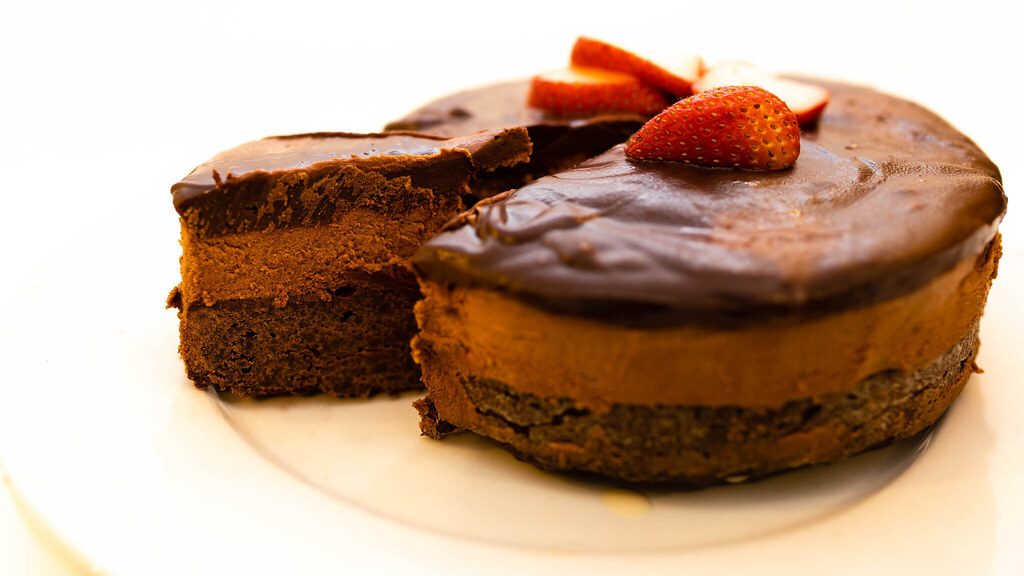
Two mousses, both legitimate, both called chocolate mousse, sharing exactly one ingredient. One is the classic French version built on egg yolks, whipped whites and cream. The other is chocolate and water. That’s the whole list.
I’ve made both a lot, and they are not variations on a theme. They set by different physics and they taste different enough that I’d serve them on different occasions.
Prep: 20 mins Chill: 4 hrs Serves: 6
Two Mousses, Two Completely Different Mechanisms
The egg version is a foam stabilised by fat and protein. The chocolate-and-water version is an emulsion whipped cold until the cocoa butter crystallises around trapped air.
That second one comes from the physical chemist Hervé This, who worked out in the late 1990s that chocolate melted into water and then whisked over ice behaves like cream, because the cocoa butter can do the same job milk fat does. It’s often sold as a trick. It isn’t. It’s a real dessert with real limits.
How the Egg Version Holds Its Air
Three separate structures do the work, which is why it survives four hours in a fridge without collapsing.
Whipped cream contributes fat globules that partially coalesce around air bubbles. Whipped egg whites contribute unfolded protein that forms a film at the air-water boundary. The yolks, stirred into warm chocolate, emulsify the whole thing and stop the cocoa butter setting into a brittle block.
The redundancy is the point. Knock the air out of the whites by over-folding and the cream still holds. That’s why the classic is forgiving even though it looks fussy.
How Chocolate and Water Alone Turn Into Mousse
Melt 7 ounces of dark chocolate into 2/3 cup of hot water and you get a thin, glossy liquid. It looks wrong. Set that bowl inside a larger bowl of ice water and whisk, and somewhere between 90 seconds and three minutes it thickens, lightens by about two shades, and holds a peak.
Cocoa butter is crystallising out as the mixture drops below about 80°F, and the crystals brace the air you’re beating in. Overshoot by twenty seconds and it goes grainy and stiff, like fudge. Melt it back over gentle heat, cool it, whisk again. I’ve rescued it three times in a row from the same bowl.
The flavour is startlingly pure, and noticeably more bitter. The texture is closer to a dense ganache foam than a cloud.
The Comparison, In One Table
| Classic egg-based | Chocolate and water | |
|---|---|---|
| Ingredients | 6–8 | 2 |
| Active time | 20 minutes, 3 bowls | 6 minutes, 2 bowls |
| Set | 4 hours in the fridge | Ready immediately, firms further in 30 minutes |
| Texture | Light, aerated, melts on the tongue | Dense, close-grained, more like whipped ganache |
| Flavour | Rounded by cream and yolk | Pure and bitter, tastes of the exact bar used |
| Raw egg | Yes, in this version | None |
| Holds overnight | Yes, 3 days | Weeps by day two |
| Margin for error | Wide | Narrow, but fully recoverable |
The One I Make, and the One I Make When Someone Can’t Eat Raw Egg
The classic wins, and it isn’t close for me.
Not because the water method is a gimmick, but because texture is most of the point of a mousse, and the egg version has a lightness the two-ingredient one can’t reach. Cocoa butter crystals are firmer than partially coalesced milk fat. You feel it. Side by side in identical glasses, the water version reads as very good chocolate, and the classic reads as mousse.
Where the water method genuinely wins: you have no cream, no eggs, and forty people arriving. It scales instantly, it’s dairy-free and egg-free, and it costs whatever the bar costs. I make it for a friend who avoids dairy, with a 70 percent bar, and she prefers it on flavour alone.
Raw Egg: The Plain Facts
The recipe below contains uncooked yolks and uncooked whites, and raw eggs can carry salmonella. Public health guidance in the US and UK is that pregnant women, infants, adults over 65 and anyone with a weakened immune system should avoid raw or lightly cooked eggs unless they’re pasteurised.
Pasteurised shell eggs work here without changes, though the whites take about 50 percent longer to whip. In the UK, British Lion mark eggs come from vaccinated flocks and the Food Standards Agency considers them safe raw for vulnerable groups. Check the labelling rather than assuming. If none of that is available, make the water version instead.
Ingredients
- 7 ounces dark chocolate, 60 to 70 percent, finely chopped.
- 3 tablespoons unsalted butter.
- 3 large eggs, separated, at room temperature.
- 1 1/4 cups heavy cream, cold, divided.
- 3 tablespoons sugar, divided.
- 1 teaspoon vanilla extract.
- A pinch of salt.
- A small pinch of cream of tartar, to stabilise the whites.
- Shaved chocolate or berries, to finish.
Instructions
- Melt the chopped chocolate and butter in a heatproof bowl over barely simmering water, stirring until smooth. Take it off and let it cool to about 105°F, warm but not hot on your wrist.
- Whisk in the yolks one at a time along with the vanilla. The mixture thickens and turns glossy. If it stiffens into a lump, the chocolate was too hot; a tablespoon of warm cream whisked in brings it back.
- Whip 1 cup of the cold cream with 1 tablespoon of sugar to soft peaks, the stage where the peak folds over on itself. Stop early. It firms up again during folding.
- In a spotlessly clean bowl, beat the whites with the salt and cream of tartar to a foam, then add the remaining 2 tablespoons of sugar in a stream and beat to soft, glossy peaks.
- Stir a heaped spoonful of the whipped cream into the chocolate to slacken it. This step matters more than it sounds; skipping it is why people end up with lumps of unmixed chocolate.
- Fold in the rest of the cream with a spatula, cutting down the middle and lifting up and over, turning the bowl a quarter each time. Stop while a few streaks remain.
- Fold in the whites in two additions, about 12 to 15 strokes each. Stop the moment the last white streak disappears.
- Spoon into six glasses, cover loosely and chill at least 4 hours. It’s edible at 2 hours and correct at 4.
- Whip the last 1/4 cup of cream, add a dollop to each glass, and finish with shaved chocolate or berries.
Making the Water Version, If You Want to Try It
- Chop 7 ounces of dark chocolate and melt it into 2/3 cup of hot water, stirring until completely smooth and glossy.
- Sit the bowl in a larger bowl of ice water and whisk hard by hand or with electric beaters.
- Watch for the colour to lighten and the whisk to leave tracks, roughly 90 seconds to 3 minutes depending on how cold the ice bath is.
- Stop at soft peaks. It sets fast at the end.
- If it turns grainy, warm it gently until fluid again, cool, and re-whisk. It survives this.
The water ratio is the one thing you can’t fudge. Too little and it seizes; too much and it never holds air. Roughly 2/3 cup water to 7 ounces of chocolate works for a 70 percent bar; for 55 to 60 percent chocolate drop to about 1/2 cup, because there’s more sugar and less cocoa butter in the bar.
Percentage Matters More Than Brand
A 70 percent bar and a 55 percent bar are not interchangeable in either method. Higher percentage means more cocoa butter and a firmer set, and less sugar, so a more bitter mousse.
At 70 percent the mousse sets quite firm; I keep the sugar as written and add a pinch more salt. At 55 percent it’s softer and sweeter, and I take the sugar down to 2 tablespoons total. Chocolate chips are the one thing to avoid outright: they carry stabilisers designed to stop them melting, which is the opposite of what you want. I keep a 66 percent bar for this and a cheaper 50 percent for brownies, where sugar and flour do most of the talking.
Why It Goes Grainy, Split, or Stiff
Grainy nearly always means water met chocolate at the wrong moment. A few drops of liquid in melting chocolate makes the sugar particles clump and the bowl seizes. A lot of liquid, as in the water method, dissolves the sugar and is fine. There’s no safe middle.
Split, with visible fat on the surface, means the chocolate was above about 115°F when the yolks went in and the emulsion broke. Whisk in warm cream a tablespoon at a time and it usually comes back.
Stiff and slightly bouncy means over-folding, or cream whipped past soft peaks before it went in. Nothing recovers that. Serve it as a pot de crème and say nothing.
Same chocolate, different problems, in homemade peanut butter cups, where tempering decides the snap, and in molten lava cakes, where the whole thing hinges on a 30-second window in the oven. If you want the same flavour in a form that keeps a week, a proper chocolate layer cake is the safer bet for a crowd.
The practical tip I’d hand anyone starting tonight: separate the eggs straight from the fridge, when the yolk membrane is firm and least likely to break, then leave the whites on the counter for 30 minutes before whipping. Cold separates cleanly, room temperature whips higher.