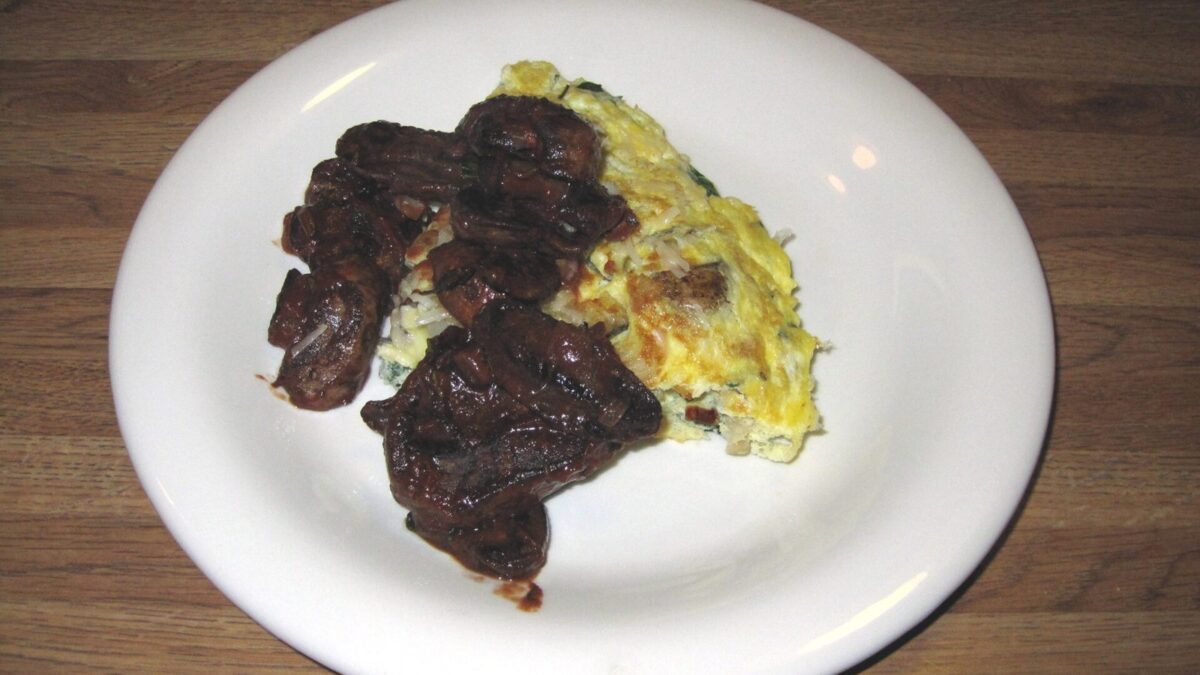
The question almost everyone asks about frittata is why theirs came out watery, with a puddle under the first slice. The answer is the vegetables, not the eggs. Courgette, mushrooms, spinach, and tomatoes are between 89 and 95 percent water by weight, and if you tip them raw into the pan that water has nowhere to go except into the custard around it.
Cook the vegetables first, properly, until the pan stops hissing and goes quiet. That sound is water boiling off. Once it stops, the moisture is gone and the eggs can set into something firm and sliceable. That single step fixes the most common frittata complaint, and everything else here is refinement on top of it.
How Much Milk Should Actually Go In?
Less than most recipes tell you. I use 60ml for eight eggs, which is about a tablespoon per two eggs, and that is the upper limit before you start pushing towards quiche territory.
Dairy does two things: it dilutes the egg proteins so they set into a softer network, and the fat coats those proteins so they squeeze together less tightly when hot. Past roughly 15ml per egg there is not enough protein per unit of liquid to hold a clean set, and the frittata weeps as it cools.
Cream is richer and more forgiving of overcooking, since the extra fat buffers it. No dairy at all gives a firmer, more distinctly eggy frittata, closer to how it is eaten in Italy.
Ingredients
- 8 large eggs, whisked until no streaks of white remain.
- 60ml whole milk, no more.
- 1 tbsp olive oil, plus a knob of butter for flavour.
- 1 small red onion, thinly sliced.
- 1 red bell pepper, diced small.
- 1 small courgette (zucchini), diced into 1cm pieces.
- 2 large handfuls baby spinach, roughly chopped.
- 100g cherry tomatoes, halved and drained cut side down for a minute.
- 80g feta or cheddar, crumbled or grated.
- 2 tbsp fresh herbs such as parsley, chives, or basil.
- Salt and black pepper.
Instructions
- Preheat the oven to 190C (170C fan). Whisk the eggs with the milk, a good pinch of salt, and plenty of black pepper for about 30 seconds, until the mixture is uniform and slightly frothy.
- Heat the olive oil and butter in a 25cm oven-safe skillet over medium heat. Add the sliced onion and cook for 3 to 4 minutes until it softens and loses its raw edge.
- Add the diced pepper and courgette. Cook for 5 to 6 minutes, stirring now and then, until the loud hissing dies down to almost nothing. That silence is your signal that the water has gone.
- Stir in the chopped spinach and cook for about a minute, just until it collapses. Scatter the halved tomatoes over the top and season lightly.
- Pour the eggs evenly over the vegetables, tilting the pan so they run into every gap. Scatter over the cheese and half the herbs.
- Let it cook undisturbed on the hob for 2 to 3 minutes, until the outer 2cm has set and pulls back slightly from the pan wall.
- Move the skillet to the oven and bake for 12 to 15 minutes, until the centre is just set with no liquid wobble and the surface is lightly golden.
- Rest for 5 minutes before cutting. Scatter the remaining herbs, then slice into wedges.
How Do You Know When It Is Actually Set?
Nudge the handle. A raw centre moves as a liquid, in a ripple that travels across the surface. A set centre moves as a whole, the way a slab does. If you see the ripple, give it another 3 minutes and look again.
With a thermometer, you want 71 to 74C at the middle. Above 80C the proteins have contracted enough to squeeze out water, and that is the other cause of a wet plate, arriving from the opposite direction to undercooked vegetables. An overcooked frittata weeps as it cools and turns slightly rubbery at the edge.
The five-minute rest is not a courtesy. Carryover heat carries the centre up another 3 or 4 degrees after it leaves the oven, which is why you pull it while it looks a shade underdone. Cut it straight from the oven and the middle will slump.
What If You Do Not Have an Oven-Safe Pan?
You can do the whole thing on the hob. Drop the heat to low once the eggs go in, put a lid on the pan, and give it 15 to 18 minutes. The trapped steam cooks the top. It sets a little less evenly and the surface stays pale rather than turning golden, but nobody at the table has ever mentioned it.
The other option is the grill, 3 to 4 minutes at about 15cm from the element. A plastic or wooden handle wants a double layer of foil and needs to stay clear of direct heat, and this is a workaround rather than a good idea. Foil slows the damage; it does not prevent it.
Pan size decides thickness and therefore timing. Eight eggs in a 20cm pan makes a deep frittata that needs closer to 20 minutes. The same eight spread thin in a 30cm pan are done in 9. My 25cm cast-iron skillet is what the 12 to 15 minute window above assumes.
Does It Keep, and Is It Any Good Cold?
Better cold than most people expect, which is the real argument for making one. It keeps for four days in the fridge, wrapped once cooled, and I would rather eat a cold wedge at my desk than reheat it badly.
Warm, then: 150C for 8 to 10 minutes under loose foil brings a whole one back without drying it. A single slice does better in a dry frying pan over low heat, 3 minutes a side. Microwaving turns the texture spongy after about 40 seconds, so use short bursts and stop early.
Frittata does not freeze well. The egg network releases water when it thaws and you get a damp, grainy wedge. If you want something eggy that genuinely survives the freezer, a pastry-based quiche is the better bet, since the crust absorbs what the filling releases.
What Else Goes On the Plate?
Something sharp and raw, is the honest answer. A frittata is soft, rich, and all one texture, and it wants contrast more than it wants another cooked side. A Greek salad with plenty of red wine vinegar does the job, and the olives echo the feta if you went that way.
For a bigger spread, a tray of roasted vegetables can go in the oven at the same 190C and come out within a few minutes of the frittata, which saves you juggling temperatures.
Can You Use Up Leftover Cooked Vegetables?
This is what a frittata is for, and it is where the water rule gets easier rather than harder. Roasted vegetables have already given up most of their moisture in the oven, so they can go straight in with the eggs after a minute in the hot pan to warm through.
Boiled and steamed leftovers are the ones to watch. Boiled potato and steamed broccoli hold water even when they look dry, so give them 4 minutes in the hot pan and let the surface catch some colour before the eggs go over.
Aim for about 400g of cooked vegetables to eight eggs. Beyond 500g there is not enough egg to bind everything and the wedges fall apart on the way to the plate. If you overshoot, whisk in a ninth egg rather than taking vegetables out. And on a weekday when even 15 minutes in the oven is too much, the low-and-slow method in my scrambled eggs write-up gets you to the same breakfast in a third of the time.