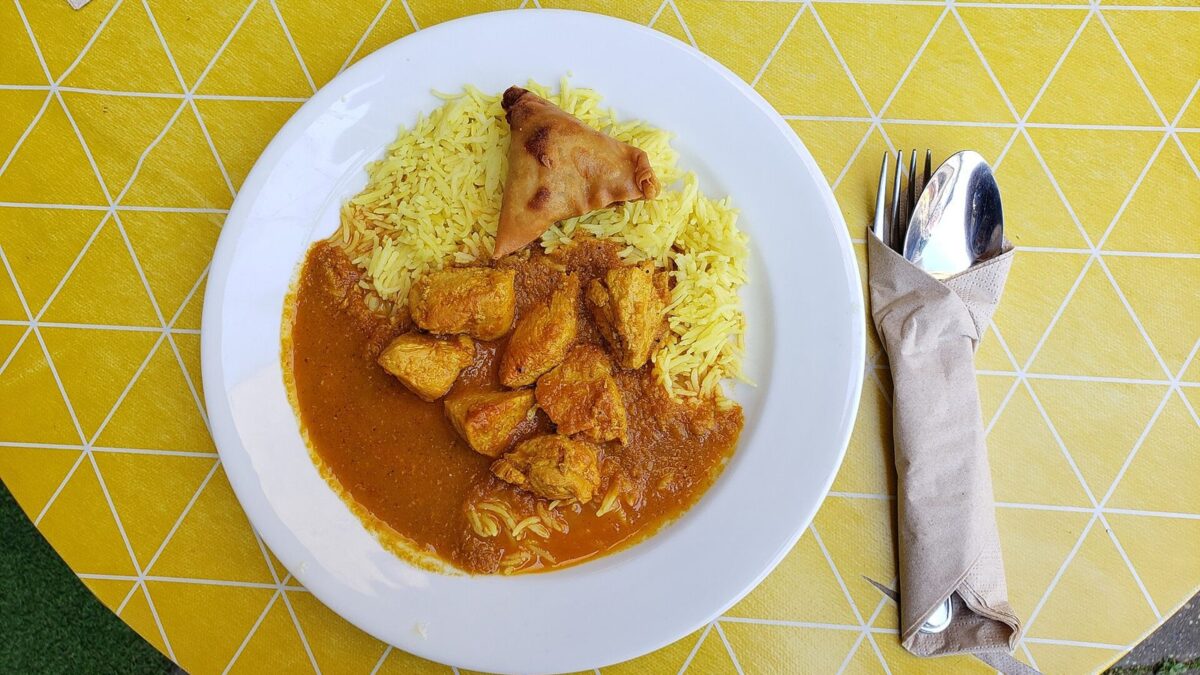
Every time I make chicken tikka masala for people, the same questions come up, usually while the sauce is still reducing. So this one is organised around them. The recipe is in the middle, and everything around it answers something I’ve actually been asked at my own kitchen counter.
What Actually Separates Tikka Masala from Butter Chicken?
They’re close relatives and the line between them has blurred in a lot of restaurants, but there are two real differences.
The first is the tomato-to-cream ratio. Butter chicken leans creamier and sweeter, often with more butter and sometimes cashew paste or a little honey. Tikka masala carries more tomato and more spice up front, so it reads sharper.
The second is texture. A classic butter chicken sauce is blended smooth. Tikka masala keeps the onion in it, so the sauce has body you can feel. Mine has visible flecks of onion and I’d fight to keep them. If you want the smoother, milder one instead, the weeknight butter chicken is a different recipe rather than a variation on this one.
Where Does the Dish Come From?
Honestly: it’s disputed, and anyone telling you a tidy single-origin story is guessing.
What isn’t disputed is that chicken tikka itself — yogurt-marinated, spiced, cooked in a tandoor — is Punjabi, and long predates the sauce. The masala sauce around it is generally accepted as a British-Indian restaurant development from somewhere in the second half of the twentieth century. The most-repeated version credits a Glasgow restaurant, and food writers have pushed back on that account as unproven. Other accounts trace it as a close cousin of butter chicken, which was itself a Delhi restaurant invention.
The one hard date worth knowing: in a 2001 speech, then UK Foreign Secretary Robin Cook described chicken tikka masala as a British national dish, which is roughly when the argument about who invented it went public.
Do I Need a Tandoor, or Will the Grill Do?
The grill does fine. A tandoor runs somewhere around 400-480°C, cooking small pieces in a couple of minutes and charring the yogurt coating before the chicken dries out. You can’t reproduce that at home, so stop trying to.
What you can reproduce is the char. Thread the marinated pieces onto skewers, set them 6 to 8cm under a preheated grill on its highest setting, and give them 4 to 5 minutes a side until the edges blacken in spots. Chicken is safe at 74°C (165°F), and thigh pieces this size will hit that at about the same moment the char appears.
The skillet method in the recipe below is faster and gets you maybe two-thirds of the way there. I use the grill when people are coming, the pan on a Wednesday. On days I want no pan at all, a curry that cooks itself in the slow cooker covers the same craving.
How Long Should the Chicken Sit in the Yogurt?
Between 4 and 6 hours is the sweet spot. Twenty minutes is the floor and it’s genuinely worth doing even then, because the yogurt coats the surface and that coating is what chars.
Yogurt is much gentler than a citrus marinade — lactic acid at that concentration works slowly, and it holds moisture against the meat rather than pulling it out. That’s why an overnight yogurt marinade is fine where an overnight lime marinade would ruin the texture. Past about 24 hours, though, the surface does start to go soft and slightly woolly.
Full-fat yogurt, always. I’ve used low-fat in a pinch and the marinade broke and slid off in the pan.
Ingredients
- 1.5 lbs boneless chicken thighs, cut into bite-sized pieces — thighs hold up to the double cooking far better than breast
- 1/2 cup plain yogurt, full fat
- 2 tablespoons lemon juice, freshly squeezed
- 4 cloves garlic, minced, divided
- 1 tablespoon fresh ginger, grated, divided
- 2 teaspoons garam masala, plus more for the sauce
- 2 teaspoons ground cumin
- 2 teaspoons paprika — Kashmiri chilli powder if you have it, for colour without much heat
- 1 large onion, finely chopped
- 1 can (14 oz) crushed tomatoes or tomato puree
- 1 cup heavy cream, or coconut cream
- 3 tablespoons butter or oil
- Salt, to taste, and fresh cilantro for garnish
Instructions
- Marinate the chicken. Combine the yogurt, lemon juice, half the garlic, half the ginger, 1 teaspoon garam masala, and a pinch of salt. Add the chicken, toss to coat, and refrigerate for at least 20 minutes — 4 to 6 hours if you have them.
- Sear the chicken. Heat 1 tablespoon of butter in a large skillet over medium-high. Add the chicken in a single layer and cook 3 to 4 minutes per side until browned in patches. It does not need to be cooked through. Remove and set aside.
- Build the base. Lower the heat to medium and melt the remaining butter. Add the onion and cook 6 to 8 minutes, stirring often, until soft and golden at the edges.
- Bloom the spices. Stir in the remaining garlic and ginger, then the cumin, paprika, and 2 teaspoons garam masala. Cook 1 minute, until the smell changes and sharpens.
- Simmer the sauce. Pour in the crushed tomatoes and a splash of water. Simmer 10 minutes, stirring occasionally, until the sauce darkens and you can see fat separating at the edges.
- Add the cream. Take the heat right down and stir in the cream. Do not let it boil after this point.
- Finish the chicken. Return the chicken and any juices. Simmer gently 8 to 10 minutes, until the thickest piece reads 74°C (165°F) and the sauce clings to a spoon.
- Taste and garnish. Season with salt, scatter with cilantro, and serve hot.
Why Is My Sauce Thin, or Worse, Split?
Two different problems with two different causes.
Thin means the tomatoes never reduced. Ten minutes at a proper simmer isn’t a suggestion — you’re waiting for the moment the colour deepens from bright red to brick and a little fat pools at the edges. If your pan is wide, that can happen in 7 minutes; in a narrow saucepan it can take 15. Watch the sauce, not the clock.
Split means the cream boiled. Dairy proteins coagulate and the fat separates out, and once it’s gone you can’t fully bring it back. Cream goes in on the lowest heat you have, and nothing after that should do more than blip.
If it does split, take it off the heat, let it drop for a minute, then whisk in a tablespoon of cold cream. That recovers it maybe half the time. Adding tomatoes cold to a very hot pan can trigger the same thing, so mind that step too.
Why Is It Bright Orange in Restaurants and Brown in My Pan?
Partly Kashmiri chilli powder, which delivers a deep red with very little heat and is the honest answer to half of it. Partly the volume of cream. And in a fair number of restaurants, food colouring — that fluorescent tandoori-red is not something spices do on their own.
Home versions land somewhere between rust and terracotta, which is what a sauce made of tomato, onion and cream actually looks like. If you want it redder without colouring, swap the paprika for Kashmiri chilli powder and add half a teaspoon of tomato paste with the spices.
Can I Make It Without Dairy?
Yes, and it’s one of the easier curries to convert. Coconut cream instead of heavy cream, one to one, and thick coconut yogurt for the marinade. The coconut is detectable but not intrusive once the garam masala is in.
Cashew cream is the more neutral option: soak 100g of raw cashews in just-boiled water for 30 minutes, drain, then blend with 120ml fresh water until completely smooth. It thickens more than dairy cream does, so hold back a splash and add water if the sauce tightens too far.
For oil, use a neutral one rather than butter — the butter is doing less here than the spices are. If you’re cooking dairy-free across a whole meal, Thai green curry and coconut curry lentil soup are already built that way, and vegetable fried rice makes a decent side if you’d rather not do plain basmati again.