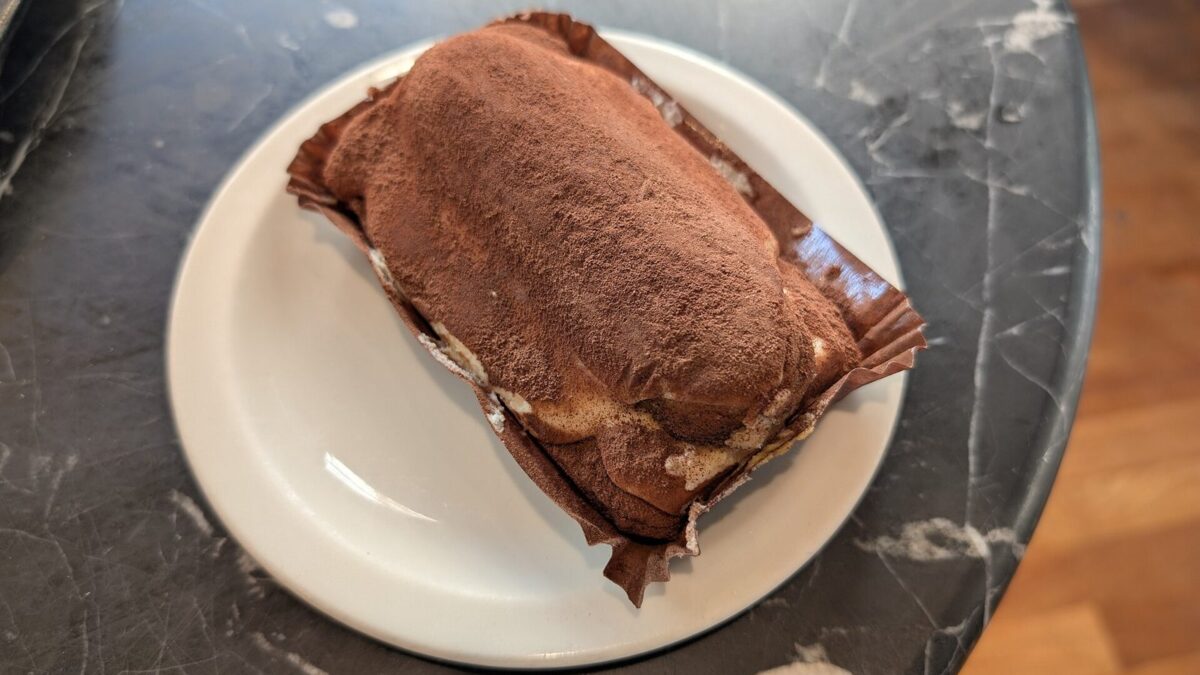
There are two honest ways to build the cream for tiramisu, and recipes tend to pick one without telling you a choice was made.
One is a raw zabaglione: yolks and sugar whisked to a foam, never heated, folded into mascarpone. The other cooks those yolks gently over a water bath first, which is the method in the recipe below. Both are traditional in the sense that both are made in Italian homes. They give you noticeably different desserts.
I’ve made this both ways, repeatedly, in the same week, so I could taste them side by side. Here’s what actually separates them.
Raw Zabaglione: Lighter Texture, Real Trade-Offs
Whisk 4 yolks with sugar until pale and tripled, fold in mascarpone, fold in whipped cream. Ten minutes, one bowl, no thermometer.
The texture is the argument for it. Uncooked yolk proteins haven’t set at all, so the cream stays loose and mousse-like, and it melts on the tongue rather than sliding off a spoon in one piece. Fresh yolk also tastes cleaner and a bit sweeter. If you’ve eaten tiramisu in Italy and remembered it as almost pourable, this is probably why.
Two costs. It’s structurally weak, which means it needs a longer chill and will slump if you try to cut a neat slice. And it contains raw egg, which is a genuine consideration rather than a formality; more on that below.
The Cooked-Yolk Base, and Why It Wins in Cups
Here the yolks, half the sugar, and 1/4 cup of water go over a pot of gently simmering water and get whisked constantly for 6 to 8 minutes until pale, thick, and doubled.
The water is doing something specific. Yolk proteins start setting around 65°C and scramble not far above it, and diluting them with water plus sugar raises the temperature at which they’d curdle, buying you a much wider margin. Without it, the six-minute window gets very unforgiving. My first attempt at this without added liquid gave me sweet scrambled egg in about ninety seconds.
What you get is a base with some set to it. It holds a layer edge, it doesn’t weep, and it carries the whipped cream without deflating. It also tastes slightly richer and more custardy, closer to crème brûlée than to a mousse.
The cost is honest: it’s fiddlier, it needs 15 to 20 minutes of cooling before the mascarpone goes in, and if you add mascarpone to a warm base it splits into a grainy mess that will not come back.
Side by Side at a Glance
| Raw zabaglione | Cooked-yolk base | |
|---|---|---|
| Texture | Loose, mousse-like, melts fast | Set, spoonable, holds an edge |
| Active time | About 10 minutes | 25 to 30 minutes with cooling |
| Minimum chill | 6 hours, overnight preferred | 4 hours |
| Raw egg | Yes | No, yolks are cooked |
| Risk of splitting | Low | Real, if the base is still warm |
| Best for | Serving from one dish, eaten same day | Individual cups, making ahead |
For cups specifically, I’d take the cooked base every time. Individual servings get carried, stacked in a fridge, and often made a day ahead, and a raw zabaglione filling will separate slightly at the base of a glass over 24 hours. You see it as a thin pale ring. It tastes fine. It looks like a mistake.
A Plain Word About Raw Eggs
Raw or lightly cooked eggs can carry Salmonella. That’s not a scare, it’s just the reason cooked-yolk versions exist. Food safety agencies in the UK, US and elsewhere advise that pregnant women, infants and young children, adults over 65, and anyone with a weakened immune system avoid dishes made with raw egg unless the eggs are pasteurised.
Practical options, in order of how much I’d bother. Use the cooked-yolk method below and the question doesn’t arise. Or buy pasteurised eggs, which are heat-treated in the shell and safe to use raw. Or, in the UK, look for the British Lion mark, which indicates hens vaccinated against Salmonella; the Food Standards Agency considers those eggs safe to eat raw for all groups.
If you’re serving to a mixed table and don’t know who’s at it, cook the yolks. I’m not a food safety professional and this isn’t medical advice, just the reason I stopped making the raw version for guests.
Ingredients
- 4 large egg yolks, the base of the mascarpone custard
- 1/2 cup granulated sugar, divided: half for the custard, half for whipping the cream
- 1/4 cup water, which helps cook the yolks gently into a smooth custard
- 16 oz mascarpone cheese, room temperature
- 1 cup heavy cream, chilled, whipped separately and folded in for lightness
- 1 1/2 cups brewed espresso or strong coffee, cooled; the darker the better
- 2-3 tbsp coffee liqueur or dark rum, optional
- 24-28 ladyfinger cookies (savoiardi), crisp and dry so they soak without turning to mush
- Unsweetened cocoa powder, for dusting
- Dark chocolate shavings, optional
Instructions
- Set up a double boiler by placing a heatproof bowl over a pot of gently simmering water, making sure the bowl doesn’t touch the water.
- Whisk the egg yolks, half the sugar, and the water together in the bowl and cook, whisking constantly, for 6-8 minutes until the mixture is pale, thick, and doubled in volume. Remove from heat and let cool to room temperature, whisking occasionally.
- Once cooled, whisk the mascarpone into the yolk mixture in two additions until smooth and no lumps remain.
- In a separate bowl, whip the heavy cream with the remaining sugar to soft-medium peaks. Gently fold the whipped cream into the mascarpone mixture in two batches, keeping the texture light and airy.
- Combine the cooled espresso with the coffee liqueur in a shallow dish. Working quickly, dip each ladyfinger for about 1 second per side, just enough to soak in, not so long it falls apart.
- Break or trim the soaked ladyfingers to fit your serving cups. Layer a piece or two in the bottom of each cup, followed by a generous layer of mascarpone cream.
- Repeat with a second layer of soaked ladyfingers and another layer of cream, finishing with cream on top and smoothing it flat.
- Cover the cups and refrigerate for at least 4 hours, though overnight is best for the flavors to fully develop.
- Just before serving, dust generously with cocoa powder and top with chocolate shavings if using.
The mascarpone temperature rule
Mascarpone straight from the fridge at 4°C will seize into lumps when it meets even a lukewarm base. Leave it out for 30 to 45 minutes until it’s soft enough to stir smoothly on its own. And go in two additions, not one, so the first half tempers the mixture before the rest arrives.
Cups Versus One Big Dish
The second comparison worth making, since it changes the recipe more than people expect.
Cups set faster. Four hours is enough because each portion is shallow, roughly 6cm deep in a standard 200ml glass, against 5 to 6cm of a 9×13 dish that wants a full overnight. Cups also solve the serving problem entirely: no first slice collapsing, no wet edge, no arguments about portion size.
What you lose is layer definition. Ladyfingers don’t fit round glasses, so you’re breaking and wedging them, and the striped cross-section of a dish tiramisu is gone. You also get proportionally more cocoa and cream per bite, which some people love and which I find slightly rich by the third spoon.
One practical note decided it for me. Soaked ladyfingers keep absorbing coffee for hours, and in a deep dish the bottom layer sits under the weight of everything above it and turns to paste by day two. In a cup almost nothing presses down. Leftover cups on day three are still good.
A dish is the better choice when you’re feeding twelve people at a table, because assembling twelve glasses takes about 25 minutes and nobody thanks you for it. It’s also the right shape if you want the version without any egg at all, which sets firmest of the three; I’ve written that one up separately as a no-bake tiramisu.
If your cream came out too loose to hold a layer, whip the heavy cream a little further next time, to firm peaks rather than soft-medium. That’s the same lever that saves a chocolate mousse, and it costs you almost nothing in lightness. What it will not fix is a split mascarpone base, which happens before the cream ever gets involved, and the only cure for that one is starting the custard again cooler. Setting agents are the other route, but gelatine in tiramisu gives you something closer to a panna cotta and I’d rather just whip the cream properly.