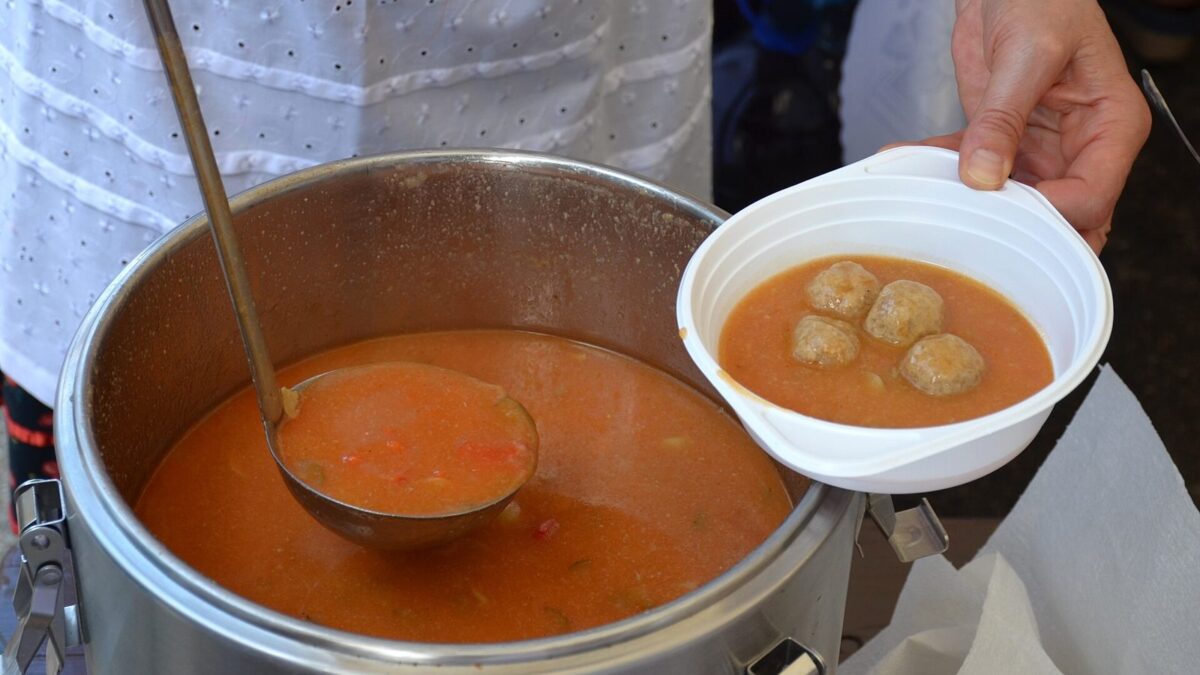
A meatball is a small test of about six decisions, and you can get five of them right and still serve something that bounces off the plate. This is the long version — what each component is actually doing, where the failure points sit, and the numbers I’ve landed on after roughly a decade of Sunday batches.
The recipe itself is a beef-and-pork mix simmered in tomato sauce, which is the version most people mean. Everything before it explains why it’s built that way.
What the Milk-Soaked Bread Is Actually Doing
The bread-and-milk paste has a name — panade — and it isn’t there to bulk out the meat. It’s there to stop the meat from squeezing out its own water.
Here’s the mechanism. Ground meat proteins, mainly myosin, start contracting and cross-linking as they heat, and by around 70°C they’ve pulled tight enough to force moisture out. That’s the same process that turns a burger into a dry puck. Wet starch interferes with it in two ways: the swollen starch granules hold water in a gel that heat doesn’t easily drive off, and they physically get in between the protein strands so the network that forms is looser and less able to contract.
One cup of breadcrumbs to a third of a cup of milk, sat for 5 minutes, gives you a thick paste rather than soup. If it’s still crunchy at 5 minutes your breadcrumbs are drier than mine — add a tablespoon more milk and wait another two.
Fresh torn bread works better than dried crumbs, if you have a stale loaf. Crusts off, torn into rough pieces, same volume, and it needs slightly more milk. Panko is the worst of the three here; it’s engineered to stay crisp and it soaks unevenly.
The Meat Blend and the Fat Floor
One pound of beef to half a pound of pork is the ratio I keep coming back to. Beef brings the flavour people recognise as a meatball; pork brings fat with a lower melting point and a softer texture, and it keeps the mixture from tasting one-note.
Fat percentage is the number that actually decides whether they’re dry. Use 80/20 beef, and with standard ground pork sitting around 20 to 25 percent fat, the blend lands somewhere near 20 percent overall. Below about 15 percent, no panade will save them. I tried an all-lean-beef batch once for a guest who’d asked, and they came out with the texture of gravel no matter how gently I handled them.
All-beef works if it’s 80/20 and you accept a firmer, chewier result. All-pork is soft and mild, closer to a Southeast Asian style than an Italian-American one. Veal in a three-way mix contributes gelatine and a very fine texture, and I’ve stopped buying it because I honestly can’t reliably pick it out in a blind taste.
Why Over-Mixed Meatballs Bounce
Salt plus mechanical work makes ground meat sticky. That stickiness is dissolved myosin, and once it’s dissolved it sets into a continuous elastic gel as it cooks. That’s exactly what you want in a sausage or a fish cake — it’s the reason a good frankfurter has snap. It’s the opposite of what you want here.
The mixing rule I use: hands, not a spoon, not a stand mixer, and stop at the point where you can no longer see a distinct streak of parsley or a pale patch of pork. That’s usually 20 to 30 seconds. If the mixture is tacky enough to pull at your fingers, you’ve gone about a minute too far.
Cold helps. Meat straight from the fridge resists smearing; meat that’s been sitting on the counter for half an hour goes pasty under the same handling.
Seasoning: Fry a Teaspoon First
You can’t taste raw meatball mix, and salt is the one variable where being 20 percent off is obvious in the finished dish. So don’t guess.
Take a teaspoon of the mixed mince, flatten it, and fry it in a dry pan for about a minute a side. Eat it. Then adjust the salt in the bowl. It costs 3 minutes and I’ve never once regretted spending them — usually I find I’m slightly under, because the parmesan misleads you into thinking the salt is already handled.
Remember the sauce is seasoned too, and the meatballs will sit in it for 20-odd minutes. Aim for the mince tasting properly seasoned on its own, not aggressively salty.
Ingredients
- 1 lb ground beef — 80/20, not leaner.
- 1/2 lb ground pork — for fat and softness.
- 1 cup breadcrumbs — for the panade.
- 1/3 cup milk — whole milk; skimmed works but gives a slacker paste.
- 1/2 cup grated parmesan — remember it brings salt of its own.
- 1 large egg — one, not two. Extra egg firms them up in the wrong direction.
- 3 cloves garlic, minced — fine, or it burns during the sear.
- 1/4 cup fresh parsley, chopped
- 1 teaspoon salt and 1/2 teaspoon black pepper
- 1 teaspoon dried oregano
- 2 tablespoons olive oil — for browning.
- 24 oz marinara or tomato sauce
Instructions
- In a small bowl, combine the breadcrumbs and milk and let them sit for 5 minutes until the breadcrumbs soften into a thick paste. This is the step that keeps them tender.
- In a large bowl, add the ground beef, ground pork, soaked breadcrumbs, parmesan, egg, garlic, parsley, salt, pepper, and oregano.
- Mix with your hands for 20 to 30 seconds, just until the parsley is evenly distributed and no pale streaks of pork remain. Stop there.
- Fry a teaspoon of the mixture in a dry pan, taste it, and adjust the salt if needed.
- Scoop and roll into balls about 1 1/2 inches wide — roughly 20 to 24 of them. Wet hands stop the mixture sticking.
- Heat the olive oil in a large skillet over medium-high heat. Brown the meatballs in batches, turning to sear all sides, about 6 to 8 minutes total. They do not need to be cooked through yet.
- Pour the marinara into the skillet and nestle the meatballs into it. Bring to a gentle simmer.
- Cover and simmer over low heat for 20 to 25 minutes, until the centre of a meatball reads 71°C (160°F). Stir occasionally so nothing catches.
- Taste the sauce and adjust the salt. Finish with extra parmesan and parsley.
Brown, Bake, or Poach Straight in the Sauce
Three legitimate routes, three different meatballs.
Browning in a pan is what the recipe above does, and it’s the best-tasting of the three because a seared crust gives you flavours the interior can’t produce on its own. It’s also the fiddliest — batches, splatter, and a pan to deglaze.
Baking at 200°C (400°F) on a lined tray, 18 to 20 minutes for 1.5-inch balls, gets you maybe 70 percent of the browning for about 10 percent of the effort. The flat spot where they touch the tray browns well, the top browns fairly well, and the sides stay pale. For a batch of 40 heading into the freezer, this is what I do every time.
Dropping them raw into simmering sauce gives you the softest result of all, and the sauce gets richer because everything the meatballs release stays in the pot. No crust, no browned flavour. Poach 25 to 30 minutes at a bare simmer, never a rolling boil, or they’ll break apart. Worth trying once — I was surprised how much I liked it, and I still wouldn’t serve it to someone expecting a classic.
The compromise nobody mentions: bake them, then finish 15 minutes in the sauce. You get browning and you get the sauce-soaked exterior.
Size Against Cook Time
Size is a real variable, not a preference. A 2-inch meatball takes roughly twice as long to reach temperature as a 1-inch one, and if you scale the ball without scaling the time you get a raw middle.
| Diameter | Approx weight | Yield from this recipe | Sear + simmer | Bake at 200°C / 400°F |
|---|---|---|---|---|
| 1 inch | about 25g | 36-40 | 5 min + 15 min | 12-14 min |
| 1 1/2 inch | about 45g | 20-24 | 6-8 min + 20-25 min | 18-20 min |
| 2 inch | about 85g | 11-13 | 8 min + 30-35 min | 25-28 min |
The 1-inch size is for soup — that’s the one that belongs in a broth alongside something like a proper chicken noodle. The 2-inch is a showpiece, one per plate, and it needs the longer simmer to be worth it. For pasta, 1 1/2 inches is the size that fits on a fork with a twirl of spaghetti, which is the only argument that matters.
The Temperature That Ends the Argument
Ground beef and pork mixtures are done at 71°C (160°F) at the centre. Not pink-free by eye — pink is an unreliable indicator in ground meat, and plenty of properly cooked meatballs stay faintly rosy because of how the cure-free mince reacts to the acidic sauce around it.
Push an instant-read probe in from the side, aiming for the middle, and take the lowest reading you can find. If your meatballs are 1.5 inches, the probe tip only needs to travel about 2cm.
Past about 74°C they start to firm up and dry, so the window between safe and disappointing is genuinely narrow. That’s the strongest argument for the simmer method: the sauce caps the temperature and buys you a much wider margin than a hot oven does.
Freezing Raw Against Freezing Cooked
Both work. They’re for different situations.
Raw, frozen on a tray until solid (about 2 hours) then bagged, keeps its texture better and gives you a meatball indistinguishable from fresh. Cook from frozen: brown them straight out of the bag, then add 10 minutes to the simmer. Use within 3 months, though I’ve eaten 5-month-old ones with no complaints beyond a slightly duller flavour.
Cooked, cooled fully and frozen in their sauce, is the better weeknight investment — dinner is a saucepan and 20 minutes. The texture goes very slightly firmer on reheating. Freeze in portions rather than one block, because a solid litre of frozen sauce takes an hour to come round and you will lose patience and blast it.
Don’t freeze them warm. Steam in the container becomes ice crystals on the surface, and those come back as a watery patch.
Where They Usually Go Wrong
Falling apart in the pan is almost always one of three things: not enough binder, moving them too soon, or a sauce at a hard boil. Give them a full 2 minutes before the first turn — they release from the pan when the crust forms and not a moment earlier, and prying at them is what breaks them.
Dense and heavy means over-mixing, or too much breadcrumb relative to milk. If your paste was dry and crumbly rather than gluey, that’s the culprit.
Bland despite following the salt quantities usually traces back to under-seasoned sauce, not under-seasoned meat. Taste the marinara before the meatballs go in.
And if they’re dry despite a correct panade and a 71°C reading, check your mince percentages. I’ve been sold “lean” beef labelled ambiguously more than once, and the packet is the first place to look before you blame your own technique.
Serve them over spaghetti with garlic bread for the sauce, or fold leftovers into baked ziti, which is where mine usually end up on a Tuesday. If you like the mixture and want it in a different format, meatloaf uses the same panade logic at a much bigger scale, and the timings change accordingly.