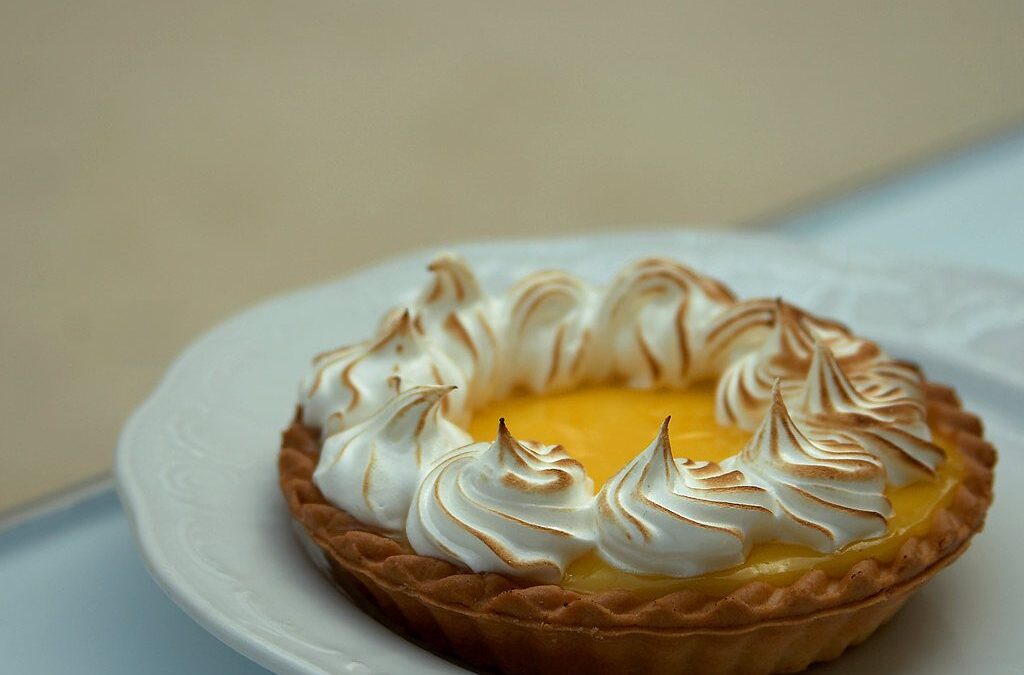
Lemon meringue pie’s reputation for being temperamental traces back to three pieces of advice that get repeated on every recipe card and are wrong. I made this pie badly for about four years before I worked out which one was sabotaging me. It was the second, and almost nobody mentions it.
Three corrections, then the recipe.
Myth 1: A weeping meringue is just what these pies do
It isn’t. Weeping is that watery layer pooling between meringue and curd, and it has one cause: undercooked egg white sitting against a filling it never bonded to. The bottom face of the meringue never got hot enough to set.
Don’t confuse it with beading — those amber droplets that appear on top of a baked meringue. That’s overcooked sugar syrup sweating out, from too long in the oven or sugar that never dissolved into the whites. Different fault, opposite fix.
The test: at stiff peaks, rub a little between finger and thumb. Gritty means the sugar hasn’t dissolved yet — beat another 30 seconds and check again. Five seconds of effort, and it’s saved me a lot of beaded pies.
Myth 2: Let the filling cool before the meringue goes on
This is the one that ruined my pies for years, because it sounds so sensible. Cool filling, cool head, tidy pie.
But a meringue is a foam, and an oven at 350°F (175°C) heats it from the top down. The bottom face — the part touching the curd — sits in shadow. If the filling under it is cold, that face never reaches the roughly 160°F (71°C) it needs to set, and you’ve built a pie with a layer of raw egg white in the middle. A few hours in the fridge and that layer collapses into liquid. There’s your weeping.
Spread the meringue onto filling that’s still genuinely hot — into the shell and topped within about five minutes, still visibly steaming. Heat rising from the curd cooks the underside while the oven browns the top. Both directions at once.
It feels wrong. You’ll be spreading soft meringue onto a hot, wobbly surface and it’ll want to slide. Do it anyway. Work from the outer edge inward and press the meringue onto the pastry rim all the way round before you fill the middle — sealing to the crust is what stops it shrinking into an island as it cools.
Myth 3: Cream of tartar is optional
Recipes list it, then add “or skip it” in brackets, which is how most people learn to skip it. Cream of tartar is an acid, and acid lowers the pH of the whites enough to stop the proteins bonding too tightly to each other. Over-bonded protein is what squeezes water out of a foam.
In practice: a meringue with 1/4 teaspoon of cream of tartar holds its peaks on the counter for 20 minutes while you faff with the oven. Without it, the same meringue slumps in about five and starts pooling liquid at the base of the bowl. No cream of tartar? Half a teaspoon of lemon juice does roughly the same job, and you’ve already got lemons out. Nothing at all is the option that fails.
Ingredients
- 1 pre-baked 9-inch pie crust – homemade or store-bought, fully cooled.
- 1 1/3 cups granulated sugar – divided between curd and meringue.
- 1/4 cup cornstarch – to thicken the lemon filling.
- 1 1/2 cups water – the base for the curd.
- 1/2 cup fresh lemon juice – about 3 to 4 lemons.
- 1 tablespoon lemon zest – zest before you juice, not after.
- 4 large egg yolks – lightly beaten, for a rich curd.
- 2 tablespoons butter – for a glossy, smooth filling.
- 4 large egg whites – room temperature, for the meringue.
- 1/4 teaspoon cream of tartar – stabilizes the meringue.
- 1/2 cup sugar (for meringue) – added slowly for stiff peaks.
- 1/2 teaspoon vanilla extract – to round out the meringue.
Bottled lemon juice sets exactly the same. It just tastes flat against all that sugar, and there’s nowhere for it to hide in a pie this plain.
Instructions
- Preheat the oven to 350°F (175°C) and have your cooled, pre-baked crust ready on a baking sheet. Beat the egg whites before you start the curd — the timing only works if the meringue is standing ready.
- Beat the whites with the cream of tartar until foamy, then add the 1/2 cup of sugar a tablespoon at a time, beating until stiff, glossy peaks form. Beat in the vanilla. Rub a little between your fingers; if it’s gritty, keep going. Set the bowl aside.
- In a saucepan, whisk together 1 cup sugar, the cornstarch and the water. Cook over medium heat, stirring constantly, until thick and bubbling — about 5 to 7 minutes. It has to actually boil or the cornstarch won’t reach full thickening power.
- Temper the yolks: whisk a few spoonfuls of the hot mixture into them, then pour the yolks back into the pan, stirring quickly.
- Cook 2 minutes more, then take it off the heat and stir in the lemon juice, zest and butter until smooth and glossy. Pour straight into the crust.
- Working fast while the filling is still steaming, spread the meringue over it. Seal it to the pastry rim all the way around first, then fill in the centre.
- Pull up peaks with the back of a spoon. Keep them short — tall thin spikes scorch black before the rest colours.
- Bake 12 to 15 minutes, until the peaks are golden and the valleys are pale gold. Check at 10; ovens vary more than recipes admit.
- Cool at room temperature for 1 hour, then refrigerate at least 3 hours before slicing. Don’t cover it while it’s warm — condensation on the lid drips back down and undoes everything.
What still goes wrong in my kitchen
Zest getting into the whites. Any trace of oil kills a meringue foam, and zest carries oil. I zest onto a separate plate now, well away from the mixer, after a batch refused to climb past soft foam and I spent half an hour blaming the eggs.
The other one: a curd that’s perfect in the pan and loose by morning. That’s acid added too early. If the lemon juice goes in while the pan is still boiling, it breaks down the cornstarch chains and the set weakens. Off the heat first, then the juice.
Cutting a slice that doesn’t drag
Long thin knife, dipped in hot water, wiped dry between every cut. A wet blade drags the meringue and smears curd across the face. Fridge-cold cuts far more cleanly than room temperature.
The pie peaks in the first 24 hours and is tired by day three. Meringue is not a make-ahead component. For a citrus dessert you can build two days early, key lime pie is the better choice, and lemon raspberry cheesecake bars keep even longer.
If the curd never thickened
Back into the pan, proper rolling boil, one full minute, stirring hard. Nine times out of ten it never actually boiled and the cornstarch was half-asleep. Still loose? Whisk a teaspoon of cornstarch into a tablespoon of cold water, stir it in, boil another minute.
A curd thinned by reheating after the juice went in can’t be rescued. Turn it into a lemon sauce for ice cream and start again. The crust will wait.
Torch or oven?
A torch gives prettier, more controlled colour — that leopard-spotted finish you get on a crème brûlée top. But it only browns the surface and puts almost no heat into the underside, so if you torch, the hot-filling rule stops being advice and becomes the only thing cooking that bottom layer.
I’d take the oven, and it isn’t close. Twelve minutes at 350°F browns and cooks in one go, and it forgives a pie you assembled slower than planned. Keep the torch for evening out a pale patch. For the flakiest shell under all this, the blind-baking method in my classic apple pie post is what I use for this crust too.