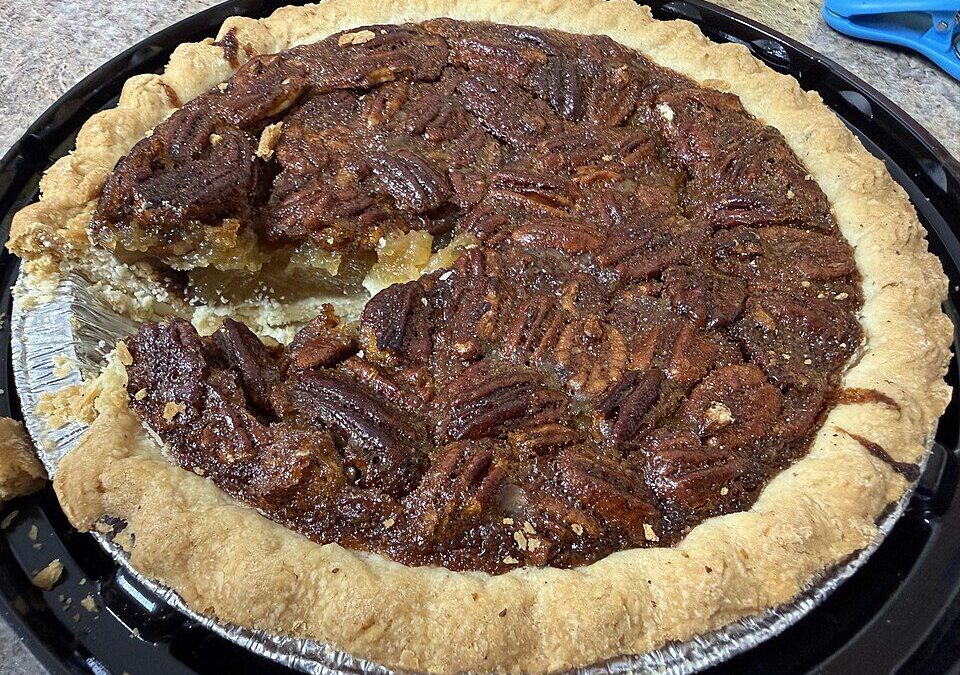
Pecan pie fails in a small number of very specific ways, and every one of them is diagnosable from the slice. Runny middle, a filling that has split into two layers, nuts gone bitter on top, a crust like wet cardboard, or a set so firm it bounces off the knife. I have produced all five, some of them at Thanksgiving in front of people.
So the faults come first here, then the recipe. If you have already baked one and it went wrong, find your symptom below.
The centre never set and the slice ran across the plate
Almost always underbaking, and almost always because the pie looked done. Pecan filling is an egg custard carrying a lot of sugar, and it thickens late. At 45 minutes it can still be liquid under a convincing crust.
The number that settles it is 200°F in the centre on an instant-read thermometer — where the eggs have set enough to hold and not so much that they curdle. Without one, look for a two-inch circle in the middle that wobbles as a single piece when you nudge the tin, rather than sloshing independently of the edges.
The other cause is cutting early. A warm pecan pie always looks underdone.
A wet, syrupy layer under a grainy one
This is the opposite problem. The filling separated because it overbaked — the egg proteins tightened past their limit and squeezed the syrup out, exactly like a curdled custard weeping whey. You get a coarse top layer sitting on a puddle.
Past about 210°F it starts. At 350°F on a lower rack, 55 minutes is the ceiling for a 9-inch pie, and hot-running ovens get there sooner. If yours is one of those, drop to 325°F and add ten minutes rather than pushing the temperature. A hot start does it too: a blast at 400°F sets the outer inch solid before the middle has warmed, and by the time the centre is done the ring around it is overcooked.
Bitter, blackened nuts on the surface
Pecans float. Whatever you scatter into the crust rises through the syrup and spends the entire bake sitting on top with nothing shielding it, and pecans have enough oil to go from toasted to acrid in a few minutes.
Two fixes. Toast them lightly and briefly beforehand — 6 to 8 minutes at 350°F, pulled the moment they smell nutty, not when they look dark, because they will toast again in the pie. And tent a loose sheet of foil over the whole pie at the 35-minute mark. I do this every time now. The nuts on my first few pies had a bitter edge I kept blaming on the pecans themselves.
Chopping half of them also helps, since chopped pieces sink into the filling and only the whole halves you arrange on top are exposed.
The base was pale and soggy
Raw pastry plus a wet filling plus a middle oven rack is a soggy bottom every time. The filling insulates the base from above, so the only heat reaching it comes from below and it is not enough.
Cheapest fix: bake on the lowest third rack with a heavy baking sheet preheated in the oven, and slide the pie tin straight onto the hot sheet. That contact heat sets the base in the first ten minutes.
Better fix if you have time: blind bake. Line the chilled crust with foil and beans, 15 minutes at 400°F, remove the beans, another 5 to 7 minutes until the base looks dry and sandy, then cool it slightly before filling and drop the oven to 350°F. Costs 25 minutes, and it is the difference between a crust you notice and one you scrape off the plate. The classic apple pie method for handling a wet filling is the same idea.
And chill the crust hard before it goes in — 30 minutes in the fridge or 10 in the freezer. Warm pastry slumps down the sides of the tin and pools butter into the base.
Set so firm it squeaked on the fork
Too much egg, too much flour, or both, usually from someone trying to guarantee a set after a previous runny pie. Three large eggs and one tablespoon of flour is already at the firm end of the range for this quantity of syrup. Add a fourth egg and you get something closer to a baked custard tart with nuts on it.
It also happens with fridge-cold pie served straight from the fridge. Pecan filling stiffens a lot at 40°F. Let slices sit out for 30 minutes and much of the rubberiness goes away on its own.
Ingredients
- 1 unbaked 9 inch pie crust, homemade or good quality store bought
- 2 cups pecan halves, some whole for the top, some roughly chopped
- 3 large eggs, at room temperature so they blend smoothly
- 1 cup light corn syrup, the backbone of that classic gooey texture
- 3/4 cup packed brown sugar, for a molasses depth
- 1/4 cup granulated sugar, to round out the sweetness
- 4 tablespoons unsalted butter, melted and slightly cooled
- 2 teaspoons pure vanilla extract
- 1 tablespoon bourbon, optional but lovely
- 1/2 teaspoon salt, to keep it from tasting flat
- 1 tablespoon all purpose flour, to help the filling set
Instructions
- Heat the oven to 350°F with a rack in the lower third and a heavy baking sheet on it. Roll the crust into a 9 inch pie dish, crimp the edge, and chill it in the fridge for at least 30 minutes while you work.
- Spread the pecans on a tray and toast for 6 to 8 minutes, pulling them as soon as they smell nutty. Roughly chop half and leave half as whole halves. Let them cool.
- Whisk the eggs in a large bowl until light and slightly foamy, about 30 seconds. Add the corn syrup, brown sugar and granulated sugar and whisk until there are no visible sugar streaks.
- Whisk in the melted butter, vanilla, bourbon if using, salt and flour until glossy and uniform. Do not aerate it more than you have to — a lot of whisked-in air turns into a foam layer on top.
- Scatter the chopped pecans over the chilled crust, then arrange the whole halves in a ring on top. Pour the filling slowly over them; the nuts will lift and settle.
- Slide the tin onto the preheated baking sheet and bake 50 to 55 minutes. Tent the top loosely with foil at the 35-minute mark.
- Start checking at 48 minutes. It is done at 200°F in the centre, or when a two-inch circle in the middle jiggles as one firm mass.
- Cool on a wire rack for at least 2 hours, and ideally 4. The filling is still setting for the first hour.
- Slice with a thin sharp knife, wiping the blade between cuts. Serve at room temperature or barely warm.
Doneness, measured rather than guessed
If you own one thermometer, use it here. The gap between 195°F and 210°F is the gap between runny and weeping, and it can be five minutes of oven time. Probe at a slight angle about an inch and a half from the centre so you are reading filling and not a nut.
The jiggle test works, but it takes a couple of pies to calibrate. What you are looking for is movement that travels through the whole centre as a unit when you tap the tin, not ripples that run out to the edge.
One more thing worth knowing: the crackly top layer that everyone wants is a thin sugar-and-egg foam that rises during baking. Overwhisking makes it thick and dry; barely whisking makes it patchy. Whisk the eggs first on their own, then fold the rest in with fewer, slower strokes.
The two hours of cooling are part of the recipe
Not a suggestion, and not an excuse to keep the kitchen tidy. Corn syrup and egg filling keeps thickening well below oven temperature, and a pie cut at 45 minutes will run even if it was perfectly baked. I cut one at Thanksgiving because six people were waiting and served what was essentially warm sauce with pastry in it. It tasted good. It did not look like pie.
Make it the day before if you can. Room temperature, loosely covered, up to two days; fridge up to a week, though the texture stiffens and wants half an hour out before serving; frozen and double-wrapped, two months. Reheating a whole pie is more trouble than it is worth, but slices come back in a 300°F oven for 10 minutes.
If your problem with pecan pie is that it is simply too sweet for you — a fair position, this is one of the sweetest things in the dessert canon — the honest answer is not to fiddle with the sugar, since the syrup is structural. Serve a smaller slice with unsweetened cream, or bake something with acid in it instead: key lime pie and classic pumpkin pie both hold a holiday table without the same sugar load. For a dark, sticky sweetness that at least comes with a sauce you can ration, sticky toffee pudding is the better use of an evening.